
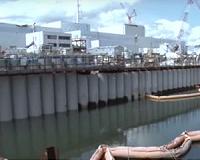
The Japanese Nuclear Regulation Authority approved a plan on Wednesday to freeze soil around the damaged reactor buildings at the Fukushima nuclear power plant to prevent contaminated water from leaking into the ocean, local media reported.
According to the Kyodo news agency, the plant's operator Tokyo Electric Power Co (TEPCO) will commence filling the underground wall around the first and forth reactors with coolant on Thursday. The plan will be applied to the entire east side of the Fukushima plant, which faces the ocean, and to most of the west side also.
TEPCO started to construct the wall in mid-2014 as a part of a $309-million project. It will reportedly take eight months to complete the project to freeze the soil.
The Fukushima Daiichi nuclear disaster took place on March 11, 2011, and was triggered by a magnitude 9.0 earthquake and subsequent tsunami. The accident is considered to be the world's worst nuclear disaster since Chernobyl. According to TEPCO, the cleanup operation, including the dismantling of the plant's reactors, may take up to 40 years to complete.
related report
TEPCO Bungles FukushimaCleanup as Defective Robots'Killed' by Radiation
The much-maligned Japanese energy company is at it again with another technological failure.
Cleanup efforts at the shuttered and leaking Fukushima nuclear plant hit the skids this week as officials were confronted with a new and unexpected challenge: radiation levels are so high that a particularly damaged reactor cannot be accessed, even by robots.
Tokyo Electric Power Company's (TEPCO) head of decommissioning, Naohiro Masuda, commented "it is extremely difficult to access the inside of the nuclear plant due to extraordinary levels of radiation."
TEPCO designed robots with Toshiba to "swim" in radioactive pools to recover containing fuel rods. "It took two years to develop this single-function robot," according to Masuda.
The Japanese energy giant soon found that their cleanup plan had failed, as robot circuitry was destroyed by the intensely strong radiation.
The same robots were used successfully in the less-toxic Reactor 4, where 1,535 fuel rod assemblies have been removed, and workers were able to stand in close enough proximity to directly observe the operation.
The robot failure adds further delay to cleanup attempts. After years of promises, this is the latest in a long line of embarrassments for TEPCO. The meltdown that led to the Fukushima disaster could have been greatly limited, but the company used radiation monitoring equipment that maxed out at 100mSv. Radiation levels were higher by a factor of 18 following the meltdown, preventing warnings and an alarm being sounded for an extended period of time.
The TEPCO-led cleanup effort has been under substantial public scrutiny. The company pumps water into reactors to cool them and then stores the radioactive water in what is reported to be leaky, illegally-constructed water tanks, creating further nuclear contamination of the surrounding environment.
TEPCO says that they are responding to the situation urgently, promising to have a new robot ready by 2017. While the company continues cleanup operations on a learn-as-you-go basis, over 8,000 workers risk their lives every day, clearing the site of radioactive debris.
