
Electronic-skin technologies for prosthetics and robots can detect the slightest touch or breeze. But oddly, the sensors that make this possible do not respond effectively to a harmful blow.
Now researchers report in ACS Applied Materials and Interfaces the development of a jellyfish-inspired electronic skin that glows when the pressure against it is high enough to potentially cause an injury.
An electronic skin that can mimic the full range of biological skin's sensitivity has great potential to transform prosthetics and robotics.
Current technologies are very sensitive, but only within a narrow range of weak pressures. Under high pressures that could cause damage, the electronic skins' sensitivity fades.
To address this shortcoming, Bin Hu and colleagues at the Huazhong University of Science and Technology turned to the Atolla jellyfish for inspiration. This bioluminescent, deep-sea creature can feel changes in environmental pressure and flashes dramatically when it senses danger.
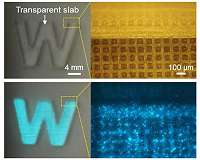
Building on the idea of a visual warning in response to a physical threat, the researchers combined electric and optical systems in a novel electronic skin to detect both slight and high-force pressures. They embedded two layers of stretchy, poly-dimethysiloxane, or PDMS, film with silver nanowires.
These layers produce an electrical signal in response to slight pressures, such as those created by a breeze or contact with a leaf. Sandwiched in between the silver nanowire electrodes is a PDMS layer embedded with phosphors.
This layer kicks in and glows with growing intensity as the physical force increases. The researchers say this approach more closely copies the wide range of pressures the human skin can feel.
Small droplets are a surprise: They disappear more slowly than they 'should'
Seemingly, we already know everything there is to know about evaporation. However, we've had another surprise: it turns out that small drops are stragglers and they evaporate more slowly than their larger counterparts, according to physicists from the Warsaw Institutes of the Polish Academy of Sciences.
This applies not only to water but also to other liquids: it turns out that very small … read more
