
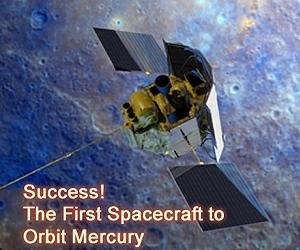
At about 9 p.m. EDT on Saint Patrick's Day, engineers at the Applied Physics Laboratory, a division of Johns Hopkins University, received confirmation that the MESSENGER (Mercury Surface, Space Environment, Geochemistry, and Ranging) spacecraft had successfully made the insertion into orbit about the planet Mercury.
This is the first spacecraft to orbit the planet closest to the sun. MESSENGER was launched over six years ago and has been maneuvering in heliocentric orbit in preparation for this historic injection event.
Next, all spacecraft systems and instruments will be tested. Once this is done, important planetary science data collection begins. Scientists hope many of Mercury's secrets will be revealed and we will learn more about the formation and evolution of Earth-like planets.
This is surely an exciting time for planetary scientists. While NASA's human space flight program is winding down and the Space Shuttle is about to be retired, there is a great deal of space science activity going on.
In addition to MESSENGER, APL has built and flown many planetary explorers, including STEREO and New Horizons. A new Solar Probe Plus spacecraft is on the drawing boards and NASA hopes to launch this mission to the sun around 2018. This spacecraft is supposed to pass within 10 solar radii of our star. Talk about hot.
This will certainly be an extraordinary and historic mission, exploring what is arguably the last region of the solar system to be visited by a spacecraft.
The Sun's outer atmosphere or corona is of primary interest and the spacecraft will repeatedly sample the near-Sun environment. This will expand our knowledge and understanding of coronal heating and the characteristics of the solar wind. Stay tuned.
Share This Article With Planet Earth
