
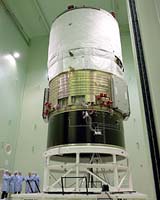
Acoustic testing of ESA's Jules Verne Automated Transfer Vehicle has been completed successfully at the agency's facilities in Noordwijk. The 11-ton test configuration of the ATV Flight Model – its the actual flight launch mass is 20.5 tons – was transferred to the Large European Acoustic Facility with the help of an air cushion transfer pad.
ESA will put the ATV – an unmanned vehicle that will deliver supplies to the International Space Station – into orbit using the Ariane-5 launch vehicle.
Acoustic testing is vital to ensure the ATV can withstand the vibrations caused by the extreme noise levels generated during launch.
Acoustic vibrations are been used to simulate the stress the ATV will encounter during the first three minutes after liftoff – due to aero dynamical forces – atop the Ariane-5. The structure of the ATV, which is the size of a double-decker London bus, will have to withstand an overall sound pressure level of 144 decibels, with main frequencies between 25 hertz and 5 kilohertz. The same amount of acoustic vibrations would be lethal for the human body.
ESA engineers conducted different test runs over several days in the special enclosed facility, LEAF. Dozens of sensors placed in different areas of the ATV have measured and checked its hardware behavior.
Two-dozen technicians and engineers from EADS Launch Vehicles – the prime contractor – EADS Space Transportation, Alcatel Alenia Space, Dutch Space (acquired by EADS Space), European Test Services and ESA coordinated the test runs.
