
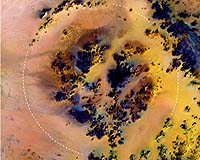
Researchers have discovered the remnants of the largest crater of the Great Sahara of North Africa, which may have been formed by a meteorite impact tens of millions of years ago. Farouk El-Baz and Eman Ghoneim of Boston University's Center for Remote Sensing made the discovery while studying satellite images of the Western Desert of Egypt.
The double-ringed crater – which has an outer rim surrounding an inner ring – is approximately 31 kilometers (nearly 19.8 miles) in diameter. Prior to the latest finding, the Sahara's biggest known crater, in Chad, measured just over 12 kilometers (7.7 miles). El-Baz said the crater's vast area suggests the impact object might have been a meteorite the entire size of Meteor Crater in Arizona, which is 1.2 kilometers (about three-quarters of a mile) wide.
El-Baz named the find Kebira, meaning "large" in Arabic, and also relates to the crater's physical location on the northern tip of the Gilf Kebir region in southwestern Egypt. He said it is uncertain why why a crater this big had never been found before.
"Kebira may have escaped recognition because it is so large – equivalent to the total expanse of the Cairo urban region from its airport in the northeast to the Pyramids of Giza in the southwest," El-Baz said. "Also, the search for craters typically concentrates on small features, especially those that can be identified on the ground. The advantage of a view from space is that it allows us to see regional patterns and the big picture."
El-Baz and Ghoneim also found evidence Kebira has suffered significant water and wind erosion, which may have helped to disguise its features. "The courses of two ancient rivers run through it from the east and west," Ghoneim said.
The local terrain is composed of 100 million year-old sandstone – the same material that underlies much of the eastern Sahara. The researchers said they hope field investigations and samples of the host rock will help determine the exact age of the crater and its surroundings.
Kebira's shape is reminiscent of the many double-ringed craters on the Moon, which El-Baz remembers from his years of work with the Apollo program. Because of this, he thinks the crater will figure prominently in future research in comparative planetology. It also could prove to be the event responsible for the extensive field of desert glass – yellow-green silica glass fragments found on the desert surface between the giant dunes of the Great Sand Sea in southwestern Egypt.
