
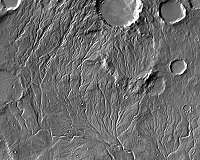
Scientists from the Open University (OU) have discovered a process that could explain the long-debated mystery of how recent and present-day surface features on Mars are formed in the absence of significant amounts of water.
Experiments carried out in the OU Mars Simulation Chamber – specialised equipment that is able to simulate the atmospheric conditions on Mars – reveal that Mars's thin atmosphere (about 7 mbar – compared to 1,000 mbar on Earth), combined with periods of relatively warm surface temperatures, causes water flowing on the surface to boil violently.
This process can then move large amounts of sand and other sediment, which effectively 'levitate' on the boiling water. This means that relatively small amounts of liquid water moving across Mars's surface could form the large dune flows, gullies and other features that characterise the Red Planet.
Jan Raack, Marie Sklodowska-Curie Research Fellow at the Open University and lead author of the research, said: "Whilst planetary scientists already know that the surface of Mars has features such as dune flows, gullies and recurring slope lineae that occur as a result of sediment transportation down a slope, the debate continues about what is forming these recent and present-day active features.
"Our research has discovered that the levitation effect caused by boiling water under low pressure enables the rapid transport of sand and sediment across the surface. This is a new geological phenomenon that doesn't happen on Earth, and could be vital to understanding similar processes on other planetary surfaces."
Raack conducted these experiments in the Hypervelocity Impact (HVI) Laboratory based at the OU. He added: "The sources of this liquid water will require more observational studies; however, the research shows that the effects of relatively small amounts of water on Mars in forming features on the surface may have been widely underestimated.
"We need to carry out more research into how water levitates on Mars, and missions such as the ESA ExoMars 2020 Rover will provide vital insights to help us better understand these processes on our closest planetary neighbour."
The research, which has been published on Friday 27 October 2017 in the academic journal Nature Communications, is funded by the Europlanet 2020 Research Infrastructure through the European Union's Horizon 2020 Research and Innovation Programme under Grant Agreement No 654208, and co-authored by academics from the STFC Rutherford Appleton Laboratory, Universitat Bern, and Universite de Nantes. The initial research concept was developed by Susan J. Conway of Universite de Nantes.
Study shows how water could have flowed on 'cold and icy' ancient Mars
For scientists trying to understand what ancient Mars might have been like, the red planet sends some mixed signals. Water-carved valleys and lakebeds leave little doubt that water once flowed on the surface. But climate models for early Mars suggest average temperatures around the globe stayed well below freezing.
A recent study led by Brown University geologists offers a potential bridge … read more
