
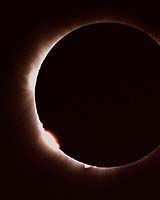
Libya is preparing to welcome thousands of Western tourists in improvised desert camps, the best place in the world to view the 29 March solar eclipse. The North African nation is to dedicate its air and sea ports to the arrival of eclipse lovers from 47 countries, including Americans, Britons and French, but excluding Israelis, tourism official Shaban al-Taeb said.
Experts from Nasa are expected, with special procedures in place to allow the solar observers to get scientific equipment into the country that was for decades off-limits to most sightseeing outsiders.
"Libya has the best conditions for observing the eclipse," said Ammar el-Latif, the tourism minister.
The eclipse "will be visible for seven minutes around Wao Namus, 2000km (1300 miles) south of Tripoli and four minutes around Battan (on the northern Egyptian border)", he said.
According to Nasa, the total eclipse will be visible as it crosses half the Earth, travelling from Brazil through northern Africa and ending up in Mongolia.
A partial eclipse will be visible along a much broader path taking in much of Europe, Africa and central Asia, but the Libyan desert has what the US space agency calls "the greatest eclipse".
The Wao Namus area is reserved for "savants" while tourists will be flown and bused to El-Bordi, close to the Egyptian border.
Cost of the visit
Tent villages with a capacity for 7000 people, described as "luxuriously equipped", have been put up in the desert to accommodate the tourists, said Abdel Razak al-Rushed, the event organiser.
The cost of the visit will be 1000 to 2000 euros per person for a maximum stay of four days, he said, including transfers to and from eclipse observation points.
The ministry of tourism has warned tour operators against over-charging during the eclipse and has mobilised five state-owned companies to deal with the influx of Westerners.
"Libya is not chasing financial gain from this event but wants to rise to the challenge" and launch its burgeoning tourism industry, a tourism official said.
Poor infrastructure
