
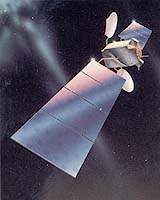
Lockheed Martin's Commercial Space Systems division announced Friday it has signed a contract with the Vietnam Posts and Telecommunications Group to provide a turnkey telecom satellite system that will begin operations in the second quarter of 2008. Financial terms of the agreement were not disclosed.
Designated VINASAT-1, the system will be based on LM's A2100A spacecraft platform and represents the first satellite ever procured by Vietnam. VINASAT-1, a C-/Ku-band hybrid satellite designed for a minimum service life of 15 years, will be located in the geostationary orbital slot 132 degrees east.
The delivery-in-orbit contract signed Friday in Hanoi calls for LM Commercial Space Systems to manage the entire project, from satellite design and manufacturing to launch procurement arrangements, followed by final extensive in-orbit testing before acceptance by the customer.
VNPT Group manages the exploration, consultation, design, installation and maintenance of telecommunications and information technology for Vietnam.
The system is expected to improve telecommunications in Vietnam by transmitting radio, television and telephone communications to all corners of the country. VINASAT-1 also will improve the nation's communication networks infrastructure by removing dependence on ground networks and allowing 100 percent of Vietnam's rural communities and hamlets to be equipped with telephones and televisions.
"VINASAT-1 will provide state-of-the-art technology that will help Vietnam enhance its role in modern world trade," said Ted Gavrilis, LMCSS's president.
LM's A2100 geosynchronous spacecraft series is designed to meet a wide variety of telecommunications needs including Ka-band broadband and broadcast services, fixed satellite services in C-band and Ku-band, high-power direct broadcast services using the Ku-band frequency spectrum and mobile satellite services using UHF, L-band, and S-band payloads.
The A2100's modular and scaleable design accommodates a large range of communication payloads as demonstrated in the 29 spacecraft successfully flown to date.
The designed-in modularity enables the A2100 to support missions in addition to communication payloads. Its design is currently being adapted for medium Earth orbit navigation missions and geostationary orbit Earth-observing missions.
