
Scientists at Los Alamos National Laboratory said they are preparing to test a new computing technology that could dramatically increase the capabilities of spacecraft.
The project – jointly sponsored by the Department of Defense and the National Nuclear Security Administration's Office of Nonproliferation Research and Development – involves orbiting an experimental payload this fall that is capable of performing more than 1 trillion operations per second.
That much capability would match the power of the best supercomputers from a decade ago – except those machines occupied as much as 50,000 cubic feet and required up to 50,000 watts of electrical power. The new technology – driven by a 90-nanometer Virtex-4 microprocessor developed by Xilinx Inc. of San Jose, Calif. – weighs only 40 pounds and requires only 80 watts of power.
"Our sensors on the Global Positioning System and Defense Satellite Program platforms have been severely constrained by the data downlinks available," said Mark Hodgson, NNSA's manager for space nuclear explosion monitoring. "This new reprogrammable supercomputing-payload technology enables our science staff to use in space the algorithms and methods previously only possible in ground-based mainframe computers, and to continually modify those methods in-situ, for better performance as science knowledge improves."
The new payload project "will be a path-breaker for our Space Nuclear Explosion Monitoring program," said W. Randy Bell, another NNSA manager, "enabling us to meet stringent new requirements for less weight and power, while growing our ability to discriminate nuclear-explosion-related signals versus natural and man-made background signals."
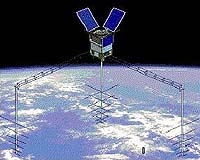
The test will be conducted aboard the Cibola Flight Experiment, due to be launched aboard a U.S. Air Force Atlas-V rocket in September from Cape Canaveral Air Force Station, Fla. Cibola, developed by SSTL of Surrey, England, comprises a reconfigurable processor payload intended for low-Earth orbit. It will survey portions of the VHF and UHF radio spectra.
The experiment will use a network of reprogrammable and field programmable gate arrays to process the received signals for ionospheric and lightning studies. The objective is to detect and measure impulsive events that occur in a complex background and would overload existing space-based computer systems.
The research partners said the technology also is aimed at boosting the power of Software-Defined Radio functions, a critical element of the military's tactical communications, and the system could be of great value to commercial television and radio broadcasting.
Along with the Virtex-4, the technology also draws on the AT697 RadHard SPARC processor by Atmel Corp., also of San Jose, Calif., and on the chalcogenide C-RAM by BAE Systems (formerly British Aerospace) of Farnborough, England.
