
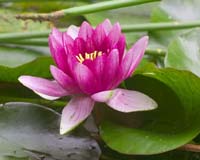
More than 100 lotus flowers from seeds flown in outer space will debut in the first Shanghai Lotus Festival on July 15 in Dongping National Forest Park on Chongming Island, the Xinhua News Agency reported.
The "space lotus seeds" traveled in space with China's first manned space vehicle, Shenzhou V, in 2003. The China Flower Association provided them to the lotus festival in Shanghai, said Fan Jie, a spokesman of the festival committee.
They will be featured along with 400 other lotus flowers throughout the two-month festival.
"'Space lotus' plants sprout within four days after planting, compared to seven to eight days for the common earthbound lotus," said Fan, who added that the seed shells are a bit harder.
The entry ticket costs 40 yuan ($5).
Shanghai's attempt at space breeding will continue. About 3,000 crop seeds from Jiading District will be sent into space this September on a return satellite, including wheat and beans.
Space seeds are more exposed to ultraviolet light and remain in high vacuum but low gravity, explained Xu Jianming, a researcher with the Chinese Academy of Space Technology. Xu said those conditions are hard to maintain for the crops and plants on Earth.
Results from the space-wheat experiment will be available after the September space trip.
Xu Lan, spokeswoman of the Shanghai Jiading District Agriculture Technology Promotion Service Center, said researchers were expecting a higher production from these seeds, but the center prefers not to promise anything before results are in.
The center had successfully grown space sweet peppers on a return satellite sent in 1997. The space wheat will be their second experiment.
China's space-breeding of plants began in 1987, and so far has put more than 400 kinds of crop seeds into space, including cucumbers, carrots and lettuce.
Return satellites were not designed to handle a large number of seeds, however.
