
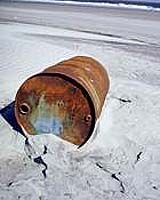
Long associated with drug trafficking, Italy's Mafia is reaping profits from a lesser known but equally lucrative racket: processing industrial waste, with potentially drastic environmental spinoffs. "These activities can have dramatic consequences on the ecosystem," warned Naples prosecutor Donato Ceglie, during a weekend meeting on the Mafia in Rome.
"The lack of controls on the territory gives the Mafia a fantastic leg up," added Ceglie, who also heads a new government observatory on environmental crimes.
The Mafia began dabbling in the industrial waste business in the mid-1980s, according to Raffaele Del Guidice, head of the environmental group Legambiente. But it was only in the 1990s that its involvement took off. "Today, an organization like Camorra (the Neapolitan Mafia) is perfectly capable of offering its waste-removal services, obviously at prices far lower than those offered by the legal sector," Del Guidice said.
Official inquiries into the garbage racket often produce the same story: waste-generating businesses that want to slice costs, transportation paid by Mafia clans and garbage dumped in little-inspected sites. Videos aired during the Rome meeting — capturing trucks dumping toxic waste on farm fields and garbage mountains going up in flames — underscore the seriousness of the problem.
Much of the activity centers on southern Italy, notably the Naples region, where iron, steel and other waste is buried, burnt and sometimes mixed with fertilizers, further increasing the risk of soil contamination. "The criminals have lots of imagination," Del Guidice said.
"One of their latest tricks is to pile tires in a pit and then pour chemicals or oil over them and set them alight to remove all traces" of the garbage. A 2005 study by Italy's Central Public Health Institute found higher mortality rates in the regions of Naples and Caserte, where most of the abuses take place. The study also found higher concentrations of tumors and congenital abnormalities in the two regions.
But while noting "major risks corresponding to zones where discharges and uncontrolled waste is discharged," it drew no definitive conclusions. For their part, magistrates deplored the lack of legislative tools to pursue the suspects. Since a 2001 illegal waste trafficking law went into effect, only 52 related inquiries have been launched across Italy. Moreover, Italy's penal code does not recognize Mafia conspiracy affecting the environment, said Ceglie, the prosecutor. "We need to move quickly," he added. "Our future and that of our children is at stake."
