
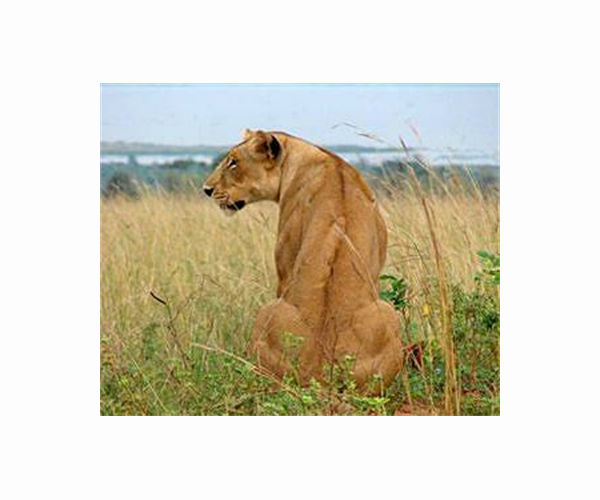
Male animals must compete with one another for food, territory and mates. Despite this, male lions prefer to work with one or more partners.
To better understand the how's and why's of coalition-building among lions, biologists from the Wildlife Institute of India and the University of Minnesota turned to the Asian lion, a single lion population confined to the forests of India's Gir National Park.
In a previous study, researchers were able to show that lion pairs had greater access to mating opportunities and were better able protect their territories than solitary lions.
"However, a lack of genetic data from the population at this stage had prevented us from determining if such cooperation extended to relatives only, or whether non-kin were included as well," Stotra Chakrabarti, a postdoctoral research associate at the University of Minnesota, said in a news release.
For the latest study, published Friday in the journal Scientific Reports, researchers combined behavioral and genetic records of known mothers, offspring and siblings to better estimate the level of relatedness between cooperating lions.
The lions of Gita don't just form pairs. Some lions form coalitions of three or four males. Researchers found lion trios and quartets were consistently composed of brothers and cousins. Their analysis also showed more than 70 percent of pairs were formed by unrelated lions.
"Forgoing mating opportunities is generally a severe evolutionary cost, unless in doing so you help related individuals," said study co-author Joseph Bump, associate professor at the University of Minnesota. "As a consequence, this evidence supports a conclusion that large male lion coalitions are feasible only when all partners are brothers and/or cousins."
Researchers found larger coalitions fared best, but the fitness of individual lions, the number of possibly sired offspring, was greater among pairs.
"The results of our study show that male coalitions prosper better than loners in established lion societies and this can have crucial implications for their conservation, especially when establishing new populations through reintroductions," said YV Jhala, principal investigator of the Gir lion project and the dean of the Wildlife Institute of India.
The integration of field observations and genetic data allowed scientists to identify new forms of coalition building, including one team of lions feature a father and sun duo.
Because siblings rarely reach maturity, researchers found larger coalitions are uncommon among Gir lions, making up just 12 to 13 percent of male teams.
Scientists also determined that among pairs, related lions weren't more likely to support one another during fights than unrelated lions.
"This shows that kin support is not the only reason why males cooperate with each other, but kin support makes the cooperation even more beneficial," Bump said.
Overall, the findings suggest cooperation among lions is quite complex — a topic ripe for further investigation.
"We have quantified the ultimate reasons why unrelated males team up, but it would be worthwhile to investigate other aspects of male cooperation, including how their bonds are forged in the first place, how they find compatible partners, what breaks the ice between them when they first meet and how they decide who will lead and who will follow," lead study author Chakrabarti said.
