
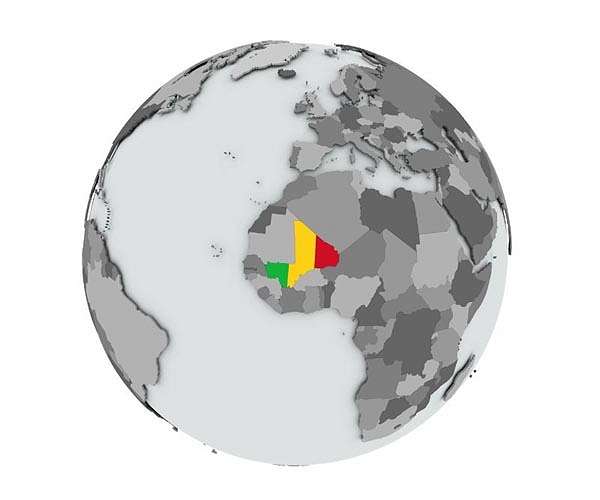
Mali's strongman ruler on Friday signed into law election legislation adopted by parliament a week ago, paving the way for polls and a return of civilian rule, according to a presidential decree.
The text, which leaves the door open to junta members seeking election, was adopted on June 17 by the National Transitional Council, the legislative body set up by Mali's ruling military junta, led by Colonel Assimi Goita.
It notably sets up a single election management body in place of a contested three-party system.
The Malian government has said that once the electoral law is adopted, it could quickly present it to the Economic Community of West African States (ECOWAS) regional bloc for approval.
It would set out the steps that would lead to elections before the return of power to civilians.
"The president of the transition, head of state, enacts the law" voted on June 17 by the NTC, said a presidential decree published Friday in the official gazette.
The NTC had in its review revised the text against the wishes of the government.
It adopted 92 amendments to the draft proposed by the government, out of 219 articles.
Among them, the structure of the single body, called the Independent Electoral Management Authority, was significantly altered in favour of civilian representation.
But the new electoral law opens the door for members of the military to run in a presidential election.
Article 155 of the new text states that "any member of the army or security forces who wishes to be a candidate for the office of president of the republic must resign or ask to retire at least six months before the end of the current mandate of the president of the republic".
The provision does not explicitly refer to Goita, the transitional president. It does say however that "for elections during the transition" would-be military contenders must stand-down from post "at least four months" before polls marking the end of the transition.
The adoption of the bill comes amid fraught negotiations between Mali and ECOWAS, whose mediator, former Nigerian president Goodluck Jonathan, arrived in Bamako on Thursday before leaving on Friday.
Jonathan began his mission nine days ahead of an ECOWAS summit in Accra due on July 3.
ECOWAS is expected to decide whether to maintain or lift the tough trade and financial sanctions imposed on Mali on January 9 in the wake of a military takeover.
Malian police officer killed in southern attack
Bamako (AFP) June 24, 2022 –
One police officer was shot dead and another wounded Thursday night in an attack on a police station in the southern Malian town of Fana, police said Friday.
"Unidentified armed individuals" attacked the station on Thursday night, the Malian police said in a statement published on social networks.
"After several exchanges of gunfire, the attackers were defeated", the statement said, adding that police, soldiers and gendarmes had worked together to fight the attack.
There has been a series of at least ten unsolved beheadings in Fana between 2018 and 2021, the city's public prosecutor said.
Fana, like much of southern Mali, has remained largely unscathed by the jihadist and inter-community violence that have for years raged in the north and centre of the country.
Al-Qaeda denies killing civilians in Mali massacre
Bamako (AFP) June 24, 2022 –
An Al-Qaeda affiliate has denied killing at least 132 civilians in three Mali villages at the weekend, the SITE Intelligence monitoring group said on Friday.
The Malian government has blamed Macina Katiba jihadists for the mass killing in Diallassagou and two surrounding villages, and says it has carried out air strikes against the group in the country's centre.
"The mujahideen (fighters) did not kill civilians and that is not their methodology," the jihadist grouping said in a statement Thursday, according to the SITE monitor of radical groups.
It claimed it only entered one village of the three reported in the media.
Its fighters went to Diallassagou to look for villagers believed to have cooperated with Malian soldiers and to have contributed to the death of "many Muslims", it said, and fired in the air when villagers came out to protest their arrival.
It denied having torched shops or taken the vehicles of "innocent people", but said it seized the property of an unknown number of people it arrested.
It said those it detained were referred to a so-called "regional sharia committee" implementing its version of Islamic law.
The massacre in and around Diallassagou was one of the worst civilian killings in Mali in recent years.
The Sahel country has since 2012 been rocked by jihadist insurgencies.
Violence began in the north and then spread to the centre and to neighbouring Burkina Faso and Niger.
