
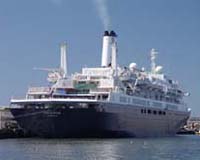
A just published Rand report entitled "Maritime and Terrorism: Risk and Liability" states that maritime terrorism risk includes cruise ships and ferries. The Insurance Journal quoted Rand report co-author Peter Chalk on Oct. 16 as saying: "Attacks on cruise ships and ferry boats would meet the interrelated requirements of visibility, destruction and disruption that drive transnational terrorism in the contemporary era. Recognizing this is essential to any comprehensive regime of maritime security."
According to the study, a terrorist attack on cruise ships and ferries could kill and injure massive numbers of passengers and cause serious financial losses.
The Rand report states that concentrating maritime counter-terrorism efforts solely on port security and cargo container ships, rail cars and trucks that import and export goods into U.S. ports is insufficient.
Report co-author Henry Willis added: "Focusing solely on securing the container supply chain without defending other parts of the maritime environment is like bolting down the front door of a house and leaving the back door wide open."
Another report author, Michael Greenberg, discussed the legal ramifications of such an attack, saying: "We need to examine closely the challenges that a maritime attack would create for our civil justice system. Tort liability is supposed to compensate victims while providing appropriate security incentives for firms. But ambiguous liability standards in the maritime terrorism context raise the prospect that the civil justice system may neither be effective as a compensation mechanism, nor in generating clear incentives for the private sector."
"Maritime and Terrorism: Risk and Liability." was produced by the RAND Center for Terrorism Risk Management Policy. Authors prepared the study by analyzing different types of terrorist attacks that could strike maritime activities, looking at possible scenarios, an attack's potential casualties and the economic fallout of a terrorist attacks.
In one of the few optimistic conclusions in the report, the study's authors noted that their review of more than 30 years of terrorist activity concluded that less than 2 percent of international terrorist attacks have hit maritime targets.
The authors attribute this to the fact it historically has been difficult to accomplish maritime terrorist attacks, coupled with the fact that maritime terrorist attacks have rarely caused a massive loss of life or generated media coverage, both important considerations for terrorists.
The authors report that while the most spectacular maritime disaster would involve detonating a nuclear weapon, most likely smuggled into a major U.S. port in a shipping container, the possibility of such an attack is far lower than for other types of attacks, arguing that bomb or chemical weapons attacks on passenger ferries or cruise ships are more probable.
Ivan Khilko and David S. Ortiz also helped to write the report.
