
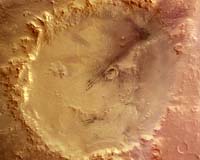
Mars Express captured this image showing the Galle Crater, a feature 230 kilometers (143 miles) wide located on the eastern rim of the red planet's Argyre Planitia impact basin.
Crater Galle lies to the east of Argyre Planitia and southwest of the Wirtz and Helmholtz craters, at 51 degrees South latitude and 329 degrees East longitude. The image shows a large stack of layered sediments forming an outcrop in the southern part of the crater. Several parallel gullies – possible evidence for liquid water on the Martian surface – originate at the inner crater walls of the southern rim.
Crater Galle, named after the German astronomer J.G. Galle (1812-1910), is known informally known as the 'happy face' crater. The face was first noticed in images taken during NASA's Viking Orbiter 1 mission in the late 1970s.
The crater's interior shows a surface shaped by Aeolian, or wind-caused, activity manifested in numerous dunes and dark dust-devil tracks which removed the bright dusty surface coating.
Ground technicians compiled the single image from five separate passes using the spacecraft's High Resolution Stereo Camera. Each pass produced an image strip covering an area tens of kilometers wide. They also derived the color from three separate HRSC image-data channels during the overlapping passes.
The image's ground resolution ranges from 10 meters to 20 meters (32.5 feet and 65 feet) per pixel, depending on the image strip – although technicians reduced the resolution to 50 meters (162.5 feet) for use on the Internet.
