
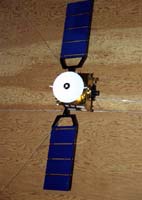
Mars Express is on target for production to start soon, while the science teams have begun forging links with ISAS, Japan's space science institute, which hopes to have its own spacecraft Nozumi in orbit about Mars soon after Mars Express arrives in 2003.
"We are following our schedule," Rudi Schmidt, Mars Express project manager, said last week at a science working team meeting attended mainly by scientists who are building payload instruments.
Project teams at Matra Marconi Space (MMS) Toulouse, the prime contractor, and at ESA's technical centre, ESTEC, are now at full strength and all sub- contractors have been appointed, said Schmidt.
Issues raised at the preliminary design review (PDR) at the end of last year (see earlier news story) have largely been resolved; and potential problems with on-board software have been avoided by reducing the inherent flexibility required of some of the spacecraft's housekeeping.
All payload instrument teams reported that they are now moving from the design phase, phase B, into the construction phase, phase C/D. They are on target for delivering EM models of their instruments to MMS after the summer, followed shortly by structural models (SM).
The EM models will be used to test the electrical interfaces of each instrument with the spacecraft and the SM models to test physical interfaces.
The meeting heard that a potential problem with vibration during launch disappeared with the first two test flights of the Soyuz-Fregat launcher.
"We had been concerned that vibration during launch would threaten the survival of some of the instruments," said Schmidt. "But the first two test flights went extremely well." Vibration levels were well below those originally given as an upper estimate by Starsem, the Russian-French launcher company.
Representatives from MMS went over the instrument testing procedures for the benefit of the instrument teams and a representative from ESOC, ESA's space operations centre in Darmstadt, Germany, summarised their progress and the capabilities of a software tool that will shortly be available to simulate the orbits of Mars Express around Mars.
The tool will help instrument scientists to plan when to turn their instruments on and off during each orbit.
