
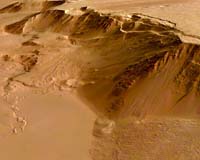
This image, taken by the High Resolution Stereo Camera on board ESA's Mars Express spacecraft, shows the eastern scarp of the Olympus Mons volcano on Mars.
The HRSC obtained the image during orbit 1,089 with a ground resolution of approximately 11 meters (36 feet) per pixel. The image is centered at 17.5 degrees North and 230.5 degrees East. The scarp is up to six kilometers (3.8 miles) high in places. Olympus is the largest known mountain in the solar system and covers an area the size of Texas.
The surface of the summit plateau's eastern flank shows lava flows that have are several kilometers long and a few hundred meters wide. Age determinations show they are up to 200 million years old – in some places even older – indicating episodic geological activity.
The lowland plains – seen here in the bottom part of the image – that lie to the east typically have a smooth surface.
Several channel-like features are visible and form a broad network of intersecting channels several kilometers long and up to 40 meters (130 feet) deep.
Several incisions suggest a tectonic control, while others show streamlined islands and terraced walls suggesting outflow activity. Age determinations show that the network-bearing area was geologically active as recent as 30 million years ago.
Between the edge of the lowland plains and the bottom of the volcano slope, there are wrinkle ridges, which mission scientists interpret as the result of compression deformation. In some places, wrinkle ridges border the arch-like terraces at the foot of the volcano slope.
