
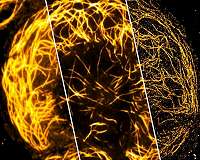
This information can be used to produce images with a resolution of about 20 to 30 nanometres, and thereby ten times that of conventional light microscopy. Until now, this method has required the use of expensive special instruments. Bielefeld University and the University of Tromso have filed a patent for this new 'chip-based nanoscopy' procedure.
On the 24th of April 2017 the researchers will be publishing the accompanying study in the journal 'Nature Photonics'.
Physicists at Bielefeld University and the Arctic University of Norway in Tromso have developed a photonic chip that makes it possible to carry out superresolution light microscopy, also called 'nanoscopy', with conventional microscopes. In nanoscopy, the position of single fluorescent molecules can be determined with a precision of just a few nanometres, that is, to a millionth of a millimetre.
This information can be used to produce images with a resolution of about 20 to 30 nanometres, and thereby ten times that of conventional light microscopy. Until now, this method has required the use of expensive special instruments. Bielefeld University and the University of Tromso have filed a patent for this new 'chip-based nanoscopy' procedure. On the 24th of April 2017 the researchers will be publishing the accompanying study in the journal 'Nature Photonics'.
Dr. Mark Schuttpelz from Bielefeld University and Dr. Balpreet Singh Ahluwalia (University of Tromso) are the inventors of this photonic waveguide chip. Professor Dr. Thomas Huser and Robin Diekmann from Bielefeld University's Biomolecular Photonics Group also worked on developing this new concept.
The invention makes experiments much easier to perform: a probe is illuminated directly on a chip about the size of a specimen slide. A lens and a camera record the signal perpendicular to the chip. The measurement data obtained can be reconstructed as superresolved images with a markedly higher resolution than that obtained with conventional microscopy.
Whereas the images that can be obtained simultaneously with established nanoscopy techniques range from only parts of cells up to just a few cells, the use of photonic chips now makes it possible to visualise more than 50 cells in one superresolution image. 'The invention of the new chip-based superresolution technique is a paradigm shift in microscopy, and it will now permit a much broader use of nanoscopy in science, research, and everyday applications,' says Dr. Mark Schuttpelz.
Current nanoscopic techniques are extremely complex, expensive, and require intensively trained technicians. Up to now, these limitations have restricted the use of nanoscopy to only highly specialized institutes throughout the world and prevented its spread to standard laboratories in biology and medicine let alone to hospitals and analytical laboratories.
Nanoimprinted hyperlens array: Paving the way for practical super-resolution imaging
The concept of a perfect lens that can produce immaculate and flawless images has been the Holy Grail of lens makers for centuries. In 1873, a German physicist and optical scientist by the name of Ernst Abbe discovered the diffraction limit of the microscope. In other words, he discovered that conventional lenses are fundamentally incapable of capturing all the details of any given image. Since … read more
