
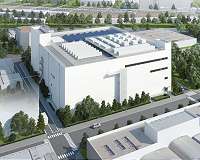
Mitsubishi Electric Corporation reports that it will invest approximately 11 billion yen to construct a new facility for the production of satellites at company's Kamakura Works in Kamakura, Japan.
Together with existing facilities, Mitsubishi Electric's production capacity will increase to 18 satellites in parallel, up from 10 in parallel at present, which will enable the company to satisfy growing demand for governmental satellites in Japan and commercial communication satellites worldwide. Mitsubishi Electric is targeting space-related revenue of 150 billion yen by 2021.
The new facility will increase production efficiency, shorten production time, reduce costs and elevate product quality for enhanced competitiveness. It will incorporate information technology based on Mitsubishi Electric's e-F@ctory solutions, which extract hidden benefits from existing resources through integrated automation to improve efficiencies, reduce costs and increasing overall productivity.
Mitsubishi Electric's long involvement with satellites includes the Himawari-7, -8 and -9 weather satellites, the Superbird-C2, Japan's first commercial communications satellite, QZS high-accuracy positioning satellite systems and the TURKSAT-4A and -4B satellites for Turksat A.S of Turkey.
The Japanese market for governmental satellites is expected to grow under the Japanese government's Basic Plan for Space Policy to develop satellites that support daily life, including for observations, communications and positioning, and to promote the commercial use of space for the enhancement of Japan's industrial and scientific infrastructure.
In the field of commercial communications satellites, which account for a steady global market, Mitsubishi Electric aims to enhance its position in this market with technologies cultivated for governmental satellites, such as next-generation engineering test satellites.
Mitsubishi Electric, a leading manufacturer for space research and development, has participated in the production of more than 500 domestic and international satellites as either the prime contractor or a major subcontractor. In 2000, the company became the first Japanese manufacturer capable of developing, designing, assembling and testing satellites at a single location.
The company's Kamakura Works is equipped with one of Japan's largest thermal-vacuum testing chambers, an acoustic test chamber and an antenna test range. To date, the works has produced 18 satellites, as well as electronic modules for the Japanese-driven H-II Transfer Vehicle (HTV) for unmanned cargo resupply in outer space.
Russian Satellite Builder Reshetnev Fully Switches to Import Substitution
Russia's Reshetnev Information Satellite Systems (ISS-Reshetnev) has fully adopted and implements import substitution technologies in production of satellites under government programs, Nikolai Testoedov, the ISS-Reshetnev director general, told Sputnik.
"The most important thing is the full mastering of the technology to design, manufacture and test telecommunication payloads for satellit … read more
