
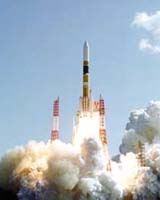
Mitsubishi Heavy Industries Ltd. plans to spend a total of 5 billion yen ($44 million) to prepare facilities for manufacturing the next-generation H-IIB domestic rocket, scheduled for launch in fiscal 2008, The Nihon Keizai Shimbun reported Tuesday.
The major heavy machinery manufacturer plans to modify and expand its welding facility for the rocket's fuel tanks at its main plant in Aichi Prefecture.
It will also construct a new building with floor space of about 900 square meters, scheduled to start operations in February 2007, on an adjacent plot of land. The firm is introducing a new friction-welding technology in order to make the H-IIB lighter.
At its Hiroshima Prefecture facility, the firm set aside space inside the plant so that it can start producing domes – key bowl-shaped parts that make up the top and bottom sections of fuel tanks – as early as this month, the report said.
Because these domes need to be processed into spherical shapes with a high degree of precision, the H-IIA rocket currently in operation relies on imports.
With a diameter of 5 meters (16,25 feet) and a length of 56 meters (182 feet), the larger H-IIB is expected to offer double the launch capability of the H-IIA. It will be able to carry two satellites at the same time or a large transfer vehicle to re-supply the International Space Station.
Japan's rocket launches have been handled by JAXA, which is under the control of the Science Ministry. But a new set-up taking effect in fiscal 2007 will allow Mitsubishi Heavy to receive orders for satellite launches from both the government and private sector.
In anticipation of this, Mitsubishi Heavy consolidated its rocket manufacturing operations earlier this fiscal year.
The H-IIB will be the first rocket in which the firm will be involved from the development stage onward.
While launching the H-IIA costs about 10 billion yen ($88 million), the H-IIB will be able to launch two satellites for an estimated 13 billion yen ($114 million). This will lower per-satellite launch costs to the level of U.S. and European firms, such as Arianespace, the report said.
Mitsubishi Heavy hopes to win orders for launching commercial satellites, which is a new area for the firm, it added.
