
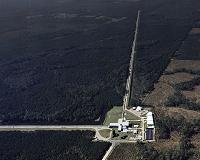
Monash researchers have identified a new concept – 'orphan memory' – which changes the current thinking around gravitational waves.
The research, by the Monash Centre for Astrophysics, was published recently in Physical Review Letters.
Einstein's theory of general relativity predicts that cataclysmic cosmic explosions stretch the fabric of spacetime.
The stretching of spacetime is called 'gravitational waves.' After such an event, spacetime does not return to its original state. It stays stretched out. This effect is called 'memory.'
The term 'orphan' alludes to the fact that the parent wave is not directly detectable.
"These waves could open the way for studying physics currently inaccessible to our technology," said Monash School of Physics and Astronomy Lecturer, Dr Eric Thrane, one of the authors of the study, together with Lucy McNeill and Dr Paul Lasky.
"This effect, called 'memory' has yet to be observed," said Dr Thrane.
Gravitational-wave detectors such as LIGO only 'hear'' gravitational waves at certain frequencies, explains lead author Lucy McNeill.
"If there are exotic sources of gravitational waves out there, for example, from micro black holes, LIGO would not hear them because they are too high-frequency," she said.
"But this study shows LIGO can be used to probe the universe for gravitational waves that were once thought to be invisible to it."
Study co-author Dr Lasky said LIGO won't be able to see the oscillatory stretching and contracting, but it will be able to detect the memory signature if such objects exist.
The researchers were able to show that high-frequency gravitational waves leave behind a memory that LIGO can detect.
"This realisation means that LIGO may be able to detect sources of gravitational waves that no one thought it could," said Dr Lasky.
Proving Einstein right using highly sensitive Earth rotation sensors
Einstein's theory of gravity, also referred to as General Relativity, predicts that a rotating body such as the Earth partially drags inertial frames along with its rotation. In a study recently published in EPJ Plus, a group of scientists based in Italy suggests a novel approach to measuring what is referred to as frame dragging.
Angela Di Virgilio of the National Institute of Nuclear Phy … read more
