
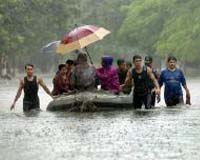
India's annual monsoon rains Tuesday approached the economic capital of Mumbai, hit by devastating floods last year, as farmers in the nation's agricultural belt waited anxiously for a downpour to sow their crops.
Forecasters said the rains would hit the western city of nearly 20 million in the next four or five days. Last July more than 400 people were killed in flash flooding during record rainfall of 94 centimetres (37 inches) in 24 hours.
Thunderstorms hit Mumbai three weeks ago, causing some flooding despite promises by city authorities to unblock storm drains and waterways blamed in part for last year's crisis.
But despite sporadic thunderstorms, the rains have largely avoided the city since then as officials scrambled to complete the work.
"Last year the rain that was experienced was an exceptional case… but we do expect heavy spells of at least 20 centimetres in 24 hours," said C.V.V. Bhadram, weather chief for India's western region. "We are prepared."
Forecasters said the monsoon — which bring crucial rains to northern India, the country's food-bowl — would likely revive in the next 48 hours.
"It will remain weak for the next 24-48 hours but we expect it to conform to our predictions of 93 percent monsoon this season," an official from the National Centre for Medium Range Weather Forecasting said in New Delhi.
"Weather models predict developments of a favourable atmospheric condition which will lead to possible revival of the monsoon over the southern peninsula on Tuesday itself," he said.
The national forecasting agency predicted dry conditions in central India for almost a week and advised farmers in areas which have experienced patchy rains so far to defer sowing of winter crops.
The southwest monsoon determines the fate of India's staple winter crops such as rice, oils, cereals, cotton and sugarcane.
The monsoon hit the southern state of Kerala and parts of western Gujarat on May 26. It brought rain to the seven northeast states and the central-eastern states of Orissa, Bihar, Jharkand and West Bengal a few days later.
It left about 140 people dead but showed signs of weakening from June 8.
