
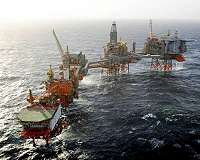
The start of production of a field containing mostly oil in the Norwegian Sea could come earlier than expected, German energy company Wintershall said.
Wintershall said its flagship Maria field offshore Norway is progressing steadily toward development by utilizing existing infrastructure to conserve capital. Drilling of the six wells slated initially for a field representing about $1.8 billion in investments started in March.
Mario Mehren, the CEO of the German energy company, said Tuesday that if development trends continue, the start of production could come as early as the first half of next year.
"With the drilling of the reservoir, we will be passing another critical milestone that moves us a step closer to first oil," he said in a statement.
Norway is a primary oil and natural gas supplier to the European market, apart from Russia. Wintershall estimates the Maria field holds about 180 million barrels of oil equivalent and most of that exists as oil.
Wintershall's trend with Maria follows a warning last week from the International Energy Agency that markets outside North America may be slowing down. The IEA said that, globally, oil discoveries hit a record low last year as spending declined in response to historically low crude oil prices. Last year posted 2.4 billion barrels of new discoveries, against a 15-year average of 9 billion barrels.
Norway reported preliminary production of 1.73 million barrels of oil, 380,000 barrels of natural gas liquids and 31,000 barrels of condensate, an ultra-light form of oil, per day in March. Oil production in particular was 8 percent higher than last year and about 4 percent higher than the government expected.
Wintershall's production reached a "historic level" of 165 million barrels of oil equivalent per day last year. Over the last 10 years, it's increased its oil and gas production by around 50 percent and doubled its commercially recoverable oil and gas reserves to 1.62 billion barrels of oil equivalent.
Iran's president leans on economic successes
Incumbent Iranian President Hassan Rouhani said easing international sections and addressing a high rate of inflation are priorities for the OPEC member state.
"The first major issue needed to be addressed was the nuclear talks and bringing to an end international sanctions against the country," he said of his first term in office. "The second problem was the rampant inflation rate whil … read more
