
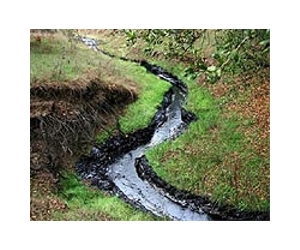
Rescue workers will be able to recover a large chunk of a giant, deadly oil spill moving down Italy's largest river by late Friday, the country's civil protection agency said.
"I think that over the next 24 hours the biggest part of this oil spill will be retrieved," agency head Guido Bertolaso said Thursday, after meeting with local officials in northern town of Piacenza, situated on confluence of the Po river and Lambro tributary where the slick originated.
"We should be able to retrieve the slick…before it arrives at Po's delta," classified as a world heritage site by UNESCO, Bertolaso added.
His remarks suggested a turnaround in efforts to contain the vast oil spill, triggered by an act of sabotage Tuesday near Milan.
Environment Minister Stefania Prestigiacomo called the spill, which has threatened wildlife, fishing grounds and tourist spots, "a true attack on the environment and on citizens' health," the ANSA news agency reported.
Several kilometers (miles) long, the slick was halfway between the cities of Cremona and Mantua late Thursday, having covered about 200 kilometres (125 miles) since it was released into the Lambro, a tributary of the Po, two days before.
Authorities had been trying to contain the flow by erecting barriers to absorb the oil, but — until now — with little success.
"The biggest operations will take place in the area of Piacenza, where we hope we will be able to stop the densest part of the slick before it enters our territory," said Gabriele Ferrari, public safety chief in the northern city of Parma.
The Veneto region, further downstream, prepared for the arrival of the slick by placing two ships across the river.
"We must do our utmost to prevent and limit the damage to the environment as well as the eventual impact on the economy and tourism in the Po delta and the Adriatic Sea, an area unique for its beauty and delicate (ecological) balance, regional fisheries chief Isi Coppola said.
Authorities have already banned fishing in the region, while a farmers' organisation expressed concern at oil polluting underground water and irrigation canals.
Stretching some 650 kilometres (400 miles), the Po flows eastward across northern Italy, irrigating the country's largest and most fertile plain, before it reaches the Adriatic.
Environmental groups criticised the handling of the oil spill.
Vittorio Cogliati Dezza, head of Legambiente, Italy's largest environmental organisation, faulted the central government and regional authorities for "incredible delays," accusing them of "underestimating the situation."
The Worldwide Fund for Nature (WWF) said the whole river ecosystem was in danger, especially the delta wetlands which were vital for the migration and wintering of seabirds.
Prestigiacomo, who visited the area to see the situation for herself, called on legal authorities to determine rapidly who was responsible for the disaster.
Share This Article With Planet Earth
