
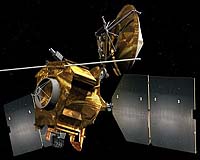
NASA's Mars Reconnaissance Orbiter completed the first critical phase of its delicate orbital-insertion maneuver on Friday.
Moving in the final stages of its 350-million-mile journey, which is designed to place the spacecraft in an ideal position to survey the red planet in unprecedented detail, the MRO successfully pressurized its fuel tank at 3:50 p.m. Eastern Time.
The operation was necessary to enable the spacecraft's thrusters to fire to slow its velocity enough for the Martian gravity to capture it.
When mission scientists received the MRO signal that pressurization had begun, they let out a cheer in the control room at NASA's Jet Propulsion Laboratory, and a comment of "that was easy" was heard.
The next move is a change in the MRO's attitude to swing its low-gain antenna into orientation with Earth. The antenna will make it easier for the controllers to stay in communication with the spacecraft during its first swing around Mars, which is expected to occur at 4:24 p.m. Eastern Time.
Doug McCuistion, director of NASA's Mars Exploration Program, reminded reporters last month that of all of the spacecraft sent to Mars, only 65 percent have been placed into orbit successfully.
Designed to examine the planet in unprecedented detail, the spacecraft should "return as much information as all previous Mars missions combined," said Michael Meyer, the orbiter's chief scientist.
Before the MRO can begin its mission, however, it must spend nearly seven months adjusting its instruments and its orbit, using an experimental process called aerobraking.
As explained by Jim Graf, the MRO mission manager, after the spacecraft's initial capture by Martian gravity – which will place it into an elongated, 35-hour orbit – the MRO will use hundreds of guided dips into the upper Martian atmosphere.
The maneuvers will apply atmospheric drag to slow the spacecraft – but not overheat it – and reshape its orbit into a nearly circular, two-hour loop at an altitude of 200 miles (321 kilometers).
This strategy allowed NASA to save 500 kilograms (1,100 lbs.) at launch, but "aerobraking is like a high-wire act in open air," Graf said. The Martian atmosphere can swell rapidly, "so we need to monitor it closely to keep the orbiter at an altitude that is effective and safe."
As the MRO nears its orbital insertion, ground controllers will expect a signal shortly after 4:30 p.m. Eastern Time indicating the main thruster – generating 260 lbs. of force – has started its 27-minute burn needed to place the spacecraft into low orbit.
That sequence will end during the 30-minute period when the orbiter flies behind Mars and falls out of radio contact. "This is obviously the critical maneuver," Graf said. "We will not see the end of the burn."
The MRO is carrying six instruments to study Mars, from its subsurface geology to its high, thin cloudtops. They include the most powerful telescopic camera ever sent to another planet – it can image rocks the size of a small desk.
Using the high-resolution camera, said Richard Zurek, JPL's orbiter project scientist, "you could be in New York and image people walking on the Mall in Washington, D.C."
He said mission scientists as usual are "especially interested in water, whether it's ice, liquid or vapor. Learning more about where the water is today and where it was in the past will also guide future studies about whether Mars ever supported life."
In addition to the camera, the orbiter carries an advanced mineral-mapper called PRISM, which can handle 600 channels of spectrographic information and can identify water-related deposits in areas as small as a baseball infield.
Its 30-foot radar antenna will probe for ice and water buried as deep as a half-mile below the surface. Its weather camera will monitor the entire planet daily, and its infrared Climate Sounder will monitor atmospheric temperatures and the movement of water vapor.
In all, the MRO represents an extension of all of NASA's planetary exploration capabilities, including – after it finishes its science mission – communications relay. "The instrumentation is unprecedented," Meyer said, adding that the orbiter can transmit data approximately 10 times faster than any previous Mars craft.
After it completes about two years of data collection, the orbiter will use its 10-foot dish antenna and transmitter powered by 102 square feet of solar cells to relay information – possibly from the indefatigable twin Mars Exploration Rovers, Spirit and Opportunity – but primarily in support of the Phoenix Mars Scout, scheduled to land near the northern polar ice cap in 2008, and the Mars Science Laboratory, a Volkswagen-sized rover planned for launch in 2009 and arrival in 2010.
"The MRO will play a major role in where the next rovers go," Meyer said, because it will study the overall Martian surface in greater detail than ever before.
For example, McCuistion explained, as Opportunity heads to a crater called Victoria, in Meridiani planum, the MRO is capable of taking such detailed images it can help MER mission controllers refine the craft's route to the formation.
"We're hoping we can actually image the rovers," he added.
