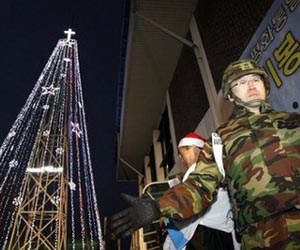
North Korea warned South Korea on Sunday of "unexpected consequences" if Seoul displays Christmas lights near the tense border, and vowed to retaliate for what it called "psychological warfare".
The South's defence ministry said earlier it was considering a request by a Seoul church group to put up Christmas lights on a steel tower shaped like a tree atop a military-controlled hill near the border.
The North's official website, Uriminzokkiri, called the plan "a mean attempt for psychological warfare" against the communist state and threatened to retaliate immediately if the lights are switched on.
The 155-metre (511 feet) hill in the South, about three kilometres (two miles) from the border, is within range of North Korean gunfire.
The tree-shaped, 30-meter-high steel structure is illuminated by thousands of small light bulbs and can be seen from the North's major city of Kaesong just north of the border, according to media reports.
"The enemy warmongers… should be aware that they should be held responsible entirely for any unexpected consequences that may be caused by their scheme," it said.
"This issue… is not something to be ignored quietly," it said.
The two Koreas in 2004 reached a deal to halt official-level cross-border propaganda and the South stopped its annual Christmas illumination ceremony.
But Seoul resumed the ceremony last December amid high military tensions with Pyongyang.
Cross-border ties have been icy since the South accused the North of torpedoing its warship with the loss of 46 lives in March 2010.
Pyongyang angrily denied involvement, but went on to shell a border island in November 2010 that left four South Koreans dead and sparked fears of war.
The North has previously accused the South of displaying Christmas lights to spread Christianity among its people and soldiers.
The North's constitution provides for religious freedom, but the US State Department says this does not exist in practice.
US says North Korea talks depend on concrete steps
Seoul (AFP) Dec 8, 2011 –
The top US envoy on North Korea Thursday urged the communist state to take concrete steps to revive long-stalled nuclear disarmament talks, saying he had no interest in "talks for talks' sake".
Glyn Davies, the US special representative on North Korea policy, said the North must honour a 2005 agreement, in which Pyongyang promised to give up nuclear programmes in return for economic and diplomatic gains.
"They need to indicate to us that they are prepared to take concrete steps to make it worthwhile to get back into the six party process," Davies told reporters during a visit to Seoul.
"I hope at some point, in the not too distant future, we will have an opportunity to get back to the table with them. But quite frankly we are not interested in talks for talks' sake," Davies said.
Davies, a former ambassador to the International Atomic Energy Agency, will also visit Japan and China on his first Asian tour since he took over the role in October.
The nuclear-armed North wants the six-party disarmament forum to resume without preconditions and says its uranium enrichment programme — first disclosed to visiting US experts one year ago — can be discussed at the talks.
The United States however says the North must first show "seriousness of purpose" toward denuclearisation by shutting down the programme.
The communist state quit the multi-party negotiations, which involve the United States, China, the two Koreas, Japan and Russia, in April 2009, a month before staging its second atomic weapons test.
Nuclear envoys from Washington and Pyongyang met in New York in July and in Geneva in October to discuss ways to revive the six-party negotiations but reported no breakthrough.
The North said earlier this month it is making rapid progress in enriching uranium and building a new reactor.
It says the enrichment is aimed at producing electricity but critics fear the project could give the North a second way to make weapons in addition to its existing plutonium-based bombs.