
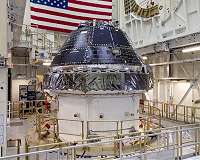
NASA is setting in motion the Orion spacecraft production line to support as many as 12 Artemis missions, including the mission that will carry the first woman and next man to the Moon by 2024.
The agency has awarded the Orion Production and Operations Contract (OPOC) to Lockheed Martin of Littleton, Colorado. Spacecraft production for the Orion program, managed at NASA's Johnson Space Center in Houston, will focus on reusability and building a sustainable presence on the lunar surface.
"This is a great day for the men and women at Johnson Space Center. They are crucial to our national space program, and have an undeniable legacy and record of success in advancing America's leadership in the human exploration of space," said Sen. Ted Cruz of Texas. "I am pleased that Administrator Bridenstine has heeded my calls and is taking significant steps to ensure that Johnson continues to grow with the exciting future of manned exploration that lies ahead. More needs to be done, and I look forward to production ramping up in the weeks and months to come and to more opportunities with NASA."
OPOC is an indefinite-delivery/indefinite-quantity contract that includes a commitment to order a minimum of six and a maximum of 12 Orion spacecraft, with an ordering period through Sept. 30, 2030. Production and operations of the spacecraft for six to 12 missions will establish a core set of capabilities, stabilize the production process, and demonstrate reusability of spacecraft components.
"This contract secures Orion production through the next decade, demonstrating NASA's commitment to establishing a sustainable presence at the Moon to bring back new knowledge and prepare for sending astronauts to Mars," said NASA Administrator Jim Bridenstine. "Orion is a highly-capable, state-of-the-art spacecraft, designed specifically for deep space missions with astronauts, and an integral part of NASA's infrastructure for Artemis missions and future exploration of the solar system."
With this award, NASA is ordering three Orion spacecraft for Artemis missions III through V for $2.7 billion. The agency plans to order three additional Orion capsules in fiscal year 2022 for Artemis missions VI through VIII, at a total of $1.9 billion. Ordering the spacecraft in groups of three allows NASA to benefit from efficiencies that become available in the supply chain over time – efficiencies that optimize production and lower costs.
Spacecraft reusability – itself a significant cost saver for the agency – will help NASA build the capabilities for sustainable exploration at the Moon and beyond. The long-term plan is to reuse the recovered crew modules at least once. The first phase of reusability will start with Artemis II. Interior components of the spacecraft, such as flight computers and other high value electronics, as well as crew seats and switch panels, will be re-flown on Artemis V. The Artemis III crew module will be re-flown on Artemis VI.
The first six spacecraft will be acquired by cost-plus-incentive-fee ordering. Because the cost of a complex, high-tech system generally decreases over time as the design stabilizes and production processes mature, NASA will negotiate firm-fixed-price orders for future missions to take advantage of the anticipated spacecraft production cost decreases. Furthermore, the cost incentives on the cost-plus-incentive-fee orders are designed to motivate favorable cost performance during early OPOC production and drive substantially lower prices for any subsequent firm-fixed-price orders issued under this contract.
"As the only vehicle capable of deep space exploration, the Orion spacecraft is critical to America's continued leadership," said Rep. Brian Babin of Texas. "Today's announcement signals that we are moving closer towards operation and production. While I look forward to learning more of the details, it's encouraging to see that this program is moving along as it should be. I am proud of the Orion program team and contractor partners at Johnson Space Center as they move towards getting the vehicle 'flight ready.' Without the brilliant minds and extraordinary leadership of the hard-working men and women at Johnson, our country would not be the preeminent spacefaring nation in the world."
Work under this contract also will support production of NASA's lunar-orbiting Gateway and evolving mission requirements. Production of certain spacecraft components already designed and qualified for Orion will be provided for Gateway use, eliminating the need for the Gateway Program to develop and qualify similar components.
"The men and women at Johnson Space Center represent the best and brightest scientific minds, and I'm confident with additional Orion spacecraft they will push the limits of exploration to the Moon and beyond," said Sen. John Cornyn of Texas. "I commend the Trump Administration for recognizing the importance and tradition of Houston as the center of human spaceflight and exploring the next frontier."
Houston has long been the hub of America's human space exploration program, from the early days of Gemini, Mercury, and Apollo to Artemis. With NASA's accelerated return to the Moon, Johnson Space Center now is managing more major human spaceflight programs than ever before. In addition to the Orion program, the Texas facility also manages NASA's Gateway and International Space Station programs, and is home to the Mission Control Center and America's astronaut corps – the next moonwalkers. Johnson also manages the agency's Commercial Lunar Payload Services, the first two deliveries for which are targeted to launch to the Moon in July 2021.
"No other spacecraft in the world can keep humans alive hundreds of thousands of miles from Earth for weeks at a time with the safety features, crew accommodations, technical innovations, and reliability that Orion provides," said Mark Kirasich, Orion Program manager at Johnson. "With the design and development phase of Orion largely behind us, this new contract will enable us to increase efficiencies, reuse the spacecraft, and bring down the cost of reliably transporting people between earth and the Gateway."
NASA is working to land the first woman and next man on the Moon in five years as part of the agency's Artemis program. Orion, the Space Launch System rocket and Gateway are part of NASA's backbone for deep space exploration. Work is well underway on both the Artemis I and II Orion spacecraft. Engineers at Kennedy Space Center in Florida have completed and attached the crew and service modules for Artemis I and are preparing the spacecraft for environmental testing. Meanwhile, teams at Kennedy are integrating thousands of parts into the crew module for Artemis II in preparation for the first crewed Artemis mission.
Top Five Technologies Needed for a Spacecraft to Survive Deep Space
https://www.nasa.gov/feature/top-five-technologies-needed-for-a-spacecraft-to-survive-deep-space
When a spacecraft built for humans ventures into deep space, it requires an array of features to keep it and a crew inside safe. Both distance and duration demand that spacecraft must have systems that can reliably operate far from home, be capable of keeping astronauts alive in case of emergencies and still be light enough that a rocket can launch it.
Artemis Missions near the Moon will start when NASA's Orion spacecraft leaves Earth atop the world's most powerful rocket, NASA's Space Launch System. After launch from the agency's Kennedy Space Center in Florida, Orion will travel beyond the Moon to a distance more than 1,000 times farther than where the International Space Station flies in low-Earth orbit, and farther than any spacecraft built for humans has ever ventured. To accomplish this feat, Orion has built-in technologies that enable the crew and spacecraft to explore far into the solar system.
Systems to Live and Breathe
As humans travel farther from Earth for longer missions, the systems that keep them alive must be highly reliable while taking up minimal mass and volume. Orion will be equipped with advanced environmental control and life support systems designed for the demands of a deep space mission. A high-tech system already being tested aboard the space station will remove carbon dioxide (CO2) and humidity from inside Orion. Removal of CO2 and humidity is important to ensure air remains safe for the crew breathing. And water condensation on the vehicle hardware is controlled to prevent water intrusion into sensitive equipment or corrosion on the primary pressure structure.
The system also saves volume inside the spacecraft. Without such technology, Orion would have to carry many chemical canisters that would otherwise take up the space of 127 basketballs (or 32 cubic feet) inside the spacecraft-about 10 percent of crew livable area. Orion will also have a new compact toilet, smaller than the one on the space station. Long duration missions far from Earth drive engineers to design compact systems not only to maximize available space for crew comfort, but also to accommodate the volume needed to carry consumables like enough food and water for the entirety of a mission lasting days or weeks.
Highly reliable systems are critically important when distant crew will not have the benefit of frequent resupply shipments to bring spare parts from Earth, like those to the space station. Even small systems have to function reliably to support life in space, from a working toilet to an automated fire suppression system or exercise equipment that helps astronauts stay in shape to counteract the zero-gravity environment in space that can cause muscle and bone atrophy. Distance from home also demands that Orion have spacesuits capable of keeping astronaut alive for six days in the event of cabin depressurization to support a long trip home.
Proper Propulsion
The farther into space a vehicle ventures, the more capable its propulsion systems need to be to maintain its course on the journey with precision and ensure its crew can get home.
Orion has a highly capable service module that serves as the powerhouse for the spacecraft, providing propulsion capabilities that enable Orion to go around the Moon and back on its exploration missions. The service module has 33 engines of various sizes. The main engine will provide major in-space maneuvering capabilities throughout the mission, including inserting Orion into lunar orbit and also firing powerfully enough to get out of the Moon's orbit to return to Earth. The other 32 engines are used to steer and control Orion on orbit.
In part due to its propulsion capabilities, including tanks that can hold nearly 2,000 gallons of propellant and a back up for the main engine in the event of a failure, Orion's service module is equipped to handle the rigors of travel for missions that are both far and long, and has the ability to bring the crew home in a variety of emergency situations.
The Ability to Hold Off the Heat
Going to the Moon is no easy task, and it's only half the journey. The farther a spacecraft travels in space, the more heat it will generate as it returns to Earth. Getting back safely requires technologies that can help a spacecraft endure speeds 30 times the speed of sound and heat twice as hot as molten lava or half as hot as the sun.
When Orion returns from the Moon, it will be traveling nearly 25,000 mph, a speed that could cover the distance from Los Angeles to New York City in six minutes. Its advanced heat shield, made with a material called AVCOAT, is designed to wear away as it heats up. Orion's heat shield is the largest of its kind ever built and will help the spacecraft withstand temperatures around 5,000 degrees Fahrenheit during reentry though Earth's atmosphere.
Before reentry, Orion also will endure a 700-degree temperature range from about minus 150 to 550 degrees Fahrenheit. Orion's highly capable thermal protection system, paired with thermal controls, will protect Orion during periods of direct sunlight and pitch black darkness while its crews will comfortably enjoy a safe and stable interior temperature of about 77 degrees Fahrenheit.
Radiation Protection
As a spacecraft travels on missions beyond the protection of Earth's magnetic field, it will be exposed to a harsher radiation environment than in low-Earth orbit with greater amounts of radiation from charged particles and solar storms that can cause disruptions to critical computers, avionics and other equipment. Humans exposed to large amounts of radiation can experience both acute and chronic health problems ranging from near-term radiation sickness to the potential of developing cancer in the long-term.
Orion was designed from the start with built in system-level features to ensure reliability of essential elements of the spacecraft during potential radiation events. For example, Orion is equipped with four identical computers that each are self-checking, plus an entirely different backup computer, to ensure Orion can still send commands in the event of a disruption. Engineers have tested parts and systems to a high standard to ensure that all critical systems remain operable even under extreme circumstances.
Orion also has a makeshift storm shelter below the main deck of the crew module. In the event of a solar radiation event, NASA has developed plans for crew on board to create a temporary shelter inside using materials on board. A variety of radiation sensors will also be on the spacecraft to help scientists better understand the radiation environment far away from Earth. One investigation called AstroRad, will fly on Artemis I and test an experimental vest that has the potential to help shield vital organs and decrease exposure from solar particle events.
Constant Communication and Navigation
Spacecraft venturing far from home go beyond the Global Positioning System (GPS) in space and above communication satellites in Earth orbit. To talk with mission control in Houston, Orion will use all three of NASA's space communications networks. As it rises from the launch pad and into cislunar space, Orion will switch from the Near Earth Network to the Space Network, made possible by the Tracking and Data Relay Satellites, and finally to the Deep Space Network that provides communications for some of NASA's most distant spacecraft.
Orion is also equipped with backup communication and navigation systems to help the spacecraft stay in contact with the ground and orient itself if it's primary systems fail. The backup navigation system, a relatively new technology called optical navigation, uses a camera to take pictures of the Earth, Moon and stars and autonomously triangulate Orion's position from the photos. Its backup emergency communications system doesn't use the primary system or antennae for high-rate data transfer.
