
The U.S. space agency says students from Massachusetts, Michigan and Pennsylvania have won its "Cassini Scientist for a Day" competition.
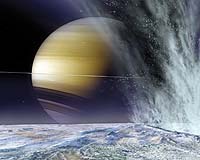
Participants had to choose one of three target areas for the National Aeronautics and Space Administration's Cassini spacecraft's camera: Saturn's moons Enceladus or Rhea, or a section of Saturn's rings that includes the tiny moon Pan. The students had to explain why their choice would yield the most scientific rewards.
Michael Keefe, a Scituate, Mass., eighth grader, chose Rhea. "A photograph of Rhea would not just give us clues about what forces are at work upon it, but also what forces have worked on other satellites," Keefe wrote.
Matt Pleatman and Noah Van Valkenburg, 11th-graders from Bloomfield Hills, Mich., also chose Rhea for their joint essay, writing, "What better moon to study than the one discovered by Cassini himself?"
Ben Basalik of Collegeville, Pa., chose Enceladus, Saturn's geologically active moon. "This moon is unusual because it reflects almost 100 percent of the sunlight that strikes it and although it is cold, it has many features that suggest that it is generating heat," wrote Basalik.
The winners were invited to discuss their essays with Cassini scientists via a teleconference.
