
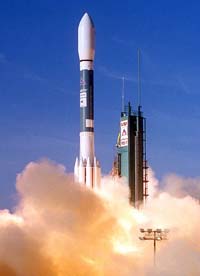
NASA scrubbed its planned launch of the CloudSat and CALIPSO missions Tuesday due to higher than allowable upper level wind conditions.
The next launch attempt will be on Wednesday at 3:02 a.m. Pacific Time, pending availability of all required Western Test Range assets. Launch commentary on NASA TV will commence at 1 a.m. PT.
Weather is a concern for Wednesday's launch attempt, however, the space agency said. The forecast calls for a 40 percent probability of acceptable weather conditions. The primary concerns are for thick clouds, a continuation of high winds, rain showers and isolated thunderstorms.
CALIPSO and CloudSat are designed to provide a three-dimensional perspective on Earth's clouds and aerosols, and to study how clouds and the airborne particles form, evolve and affect water supply, climate, weather and air quality.
CloudSat's cloud-profiling radar is more than 1,000 times more sensitive than typical weather radar. It can detect clouds and distinguish between cloud particles and precipitation.
CALIPSO – which stands for Cloud-Aerosol Lidar and Infrared Pathfinder Satellite Observation – carries an instrument that can detect aerosol particles and can distinguish between aerosol and cloud particles. "With the high resolution observation that CALIPSO will provide, we will get a better understanding of aerosol transport and how our climate system works," said David Winker, the mission's principal investigator at NASA's Langley Research Center in Hampton, Va.
Mission plans call for the satellites to be launched into a 705-kilometer (438-mile) circular, Sun-synchronous polar orbit, where they will fly in formation just 15 seconds apart as members of NASA's A-Train constellation, which includes three other Earth Observing System satellites.
A-Train includes NASA's Aqua and Aura satellites and France's Polarization and Anisotropy of Reflectances for Atmospheric Sciences coupled with observations from a Lidar satellite.
Mission managers think the data from CloudSat, CALIPSO and the other A-Train satellites will be much more useful when combined. Their measurements should improve insights into the global distribution and evolution of clouds, and lead to better weather forecasting and climate prediction.
