
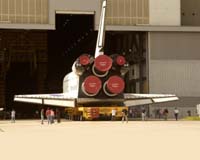
The US space agency NASA said Thursday its troubled space shuttle would stay grounded until at least March 2006, scrubbing the next launch date originally slated for September.
Shuttle engineers need more time to fix the problem of foam insulation peeling off the craft's huge external fuel tank during launch – which blighted the recent Discovery mission and doomed the Columbia orbiter in 2003.
"From an overall standpoint we think really March 4 is the timeframe we are looking at," said NASA associate administrator for space operations Bill Gerstenmaier.
"The teams are making very good progress. But we're still not complete."
NASA administrator Michael Griffin told reporters the agency had laid out a "conservative" time-frame for the next mission.
"We are trying to insert the necessary conservatism in this and that is why we are going out as far as March and giving ourselves what we hope is plenty of time to evaluate where we are," he said.
Griffin was speaking a day after some members of the Task Force, set up to probe safety improvements made after the Columbia disaster, blasted a culture of "smugness" and "arrogance" among NASA managers.
NASA also said Thursday the Discovery orbiter would be slotted into the next flight, rather than the Atlantis vessel which had been slated to perform the mission.
"Changing orbiters for (flight) STS-121 puts NASA in a better position for future missions to the Space Station," the agency said in a statement.
Atlantis is better suited to fly large segments of the yet-to-be finished International Space Station (ISS), which will form the lion's share of the shuttle's remaining workload before retirement in 2010.
Discovery safely returned earlier this month from the first shuttle mission since Columbia ripped apart on reentry after its protective shield was damaged by a piece of foam which flew off the tank, killing seven astronauts in 2003.
Thursday's announcement was the latest hitch for the often-delayed shuttle program, which will be replaced by a new vehicle to lead the US space race back to the moon and on to Mars.
Griffin said he regretted that NASA engineers had not looked at the question of foam debris earlier in the 24 years since the first shuttle mission.
"For good or ill, obviously it was ill, we in NASA did not look in detail at foam shedding from the tank for 113 flights, and shame on us," he said during a news conference at NASA's Washington offices.
Griffin also said he had ditched the idea of making a set number of shuttle flights before the vehicle is retired.
"I've changed the game on shuttle thinking, we're not trying to get a specific number of flights out of the system."
He also denied there was a "crisis of confidence" in the agency following the scathing dissent issued by seven of the task force's 26 members on Wednesday.
"There may very well be in accordance with the comments made, some issues we need to address … those sorts of things we have worked hard at NASA over the last two or three years.
"We don't suppose we are done … one of the reasons why I was very receptive to the minority report is we can't get done unless we are willing to listen to all of the hard truths."
NASA had signalled last week that it was unlikely to meet a September target for its next launch, but the expectation was that it would shoot for a November mission.
The agency had already spent 30 months and millions of dollars to improve the shuttle after the Columbia tragedy.
Discovery's mission to resupply the International Space Station and test modifications was beset by safety doubts. The shuttle needed emergency repairs and its return was delayed several times because of bad weather.
NASA nevertheless hailed the 14-day mission as a complete success.
But persistent safety concerns have raised questions about the long-term health of the shuttle program and some critics have called for scrapping it altogether to free up resources for planned missions to Mars.
NASA Targeting March for Next Shuttle Launch
Offical NASA Release
