
NASA scientists said Thursday the agency was extending the Mars mission of its Phoenix lander until the end of September, describing its progress so far as "very successful."
Michael Meyer, chief scientist of NASA's Mars Exploration Program, told reporters at a briefing that the minimum objectives of the lander's mission had been achieved and that "full mission success" was expected.
"It's been very successful and Mars had proven itself to be very interesting, mechanically the spacecraft is operating great, and there's plenty of power margin to carry us beyond the waning summer," Meyer said.
"With that, what I'd like to do is announce that we're going to extend the mission to go till the end of the fiscal year (September 30)."
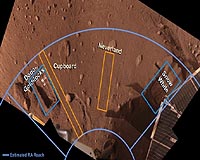
The lander started digging trenches into Martian soil after touching down near the planet's north pole on May 25, revealing a white substance that scientists confirmed was ice in June.
University of Arizona scientist Peter Smith, Phoenix's principal investigator, said ice scooped up by Phoenix's robotic digging arm was being analyzed to see if conditions on Mars could have supported life.
"We're looking to understand the history of the ice, by trying to figure out if this ice has ever melted, and through melting has created a liquid environment that modifies soil," Smith said.
"We're just getting the data back. Through this we also hope to resolve questions, is this a habitable zone on Mars, meaning that we have periodic liquid water, materials that are the basic ingredients for lifeforms."
Smith said chemical analyses which indicated soil was alkaline had baffled scientists. "This is a mystery … this is a typically acidic environment, perhaps this had to do with a nearby crater," he said.
Although important nutrients including sodium, potassium and magnesium had been discovered, no organic materials had been found so far, Smith said.
