
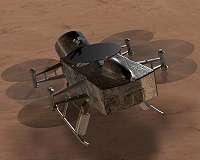
NASA on Wednesday announced two finalists for billion-dollar robotic missions — one to explore a comet and another Saturn's moon Titan — with a launch by the winner planned in the 2020s.
"These are tantalizing investigations that seek to answer some of the biggest questions in our solar system today," said Thomas Zurbuchen, associate administrator for NASA's Science Mission Directorate.
Titan is Saturn's largest moon, and is seen as one of the most likely hosts of some form of life in the solar system because of its rivers and lakes filled with methane.
The mission, called Dragonfly, would involve sending a "drone-like rotorcraft that would explore the prebiotic chemistry and habitability of dozens of sites," NASA said in a statement.
The other project would return to 67P/Churyumov-Gerasimenko, a comet that has already been visited and mapped by the European Rosetta spacecraft.
The mission, called Comet Astrobiology Exploration Sample Return (CAESAR), would aim to return a sample from 67P/Churyumov-Gerasimenko, to determine its origin and history.
"The CAESAR and Dragonfly missions will receive funding through the end of 2018 to further develop and mature their concepts," the US space agency said.
"NASA plans to select one of these investigations in the spring of 2019 to continue on to subsequent mission phases."
NASA chose the pair from a pool of 12 proposed missions, submitted in April.
The competition is part of NASA's New Frontiers program, which has also sent the Juno spacecraft into orbit around Jupiter, the New Horizons spacecraft which surveyed Pluto, and OSIRIS-REx, which launched last year to collect samples from an asteroid.
Each mission selected has a cost cap for development of approximately $850 million, with another $150 million planned for the launch.
The Moon Shines Brightly Among NASA's 2017 Highlights
The Moon became a key focus point for NASA in 2017, whether it was blocking out the Sun during one of the most-viewed events in U.S. history, or reinvigorating the agency's human space exploration plans.
One of the numerous NASA-related activities and actions the Trump Administration did in 2017 was to reconstitute the National Space Council. During its first meeting on Oct. 5, Vice Presid … read more
