
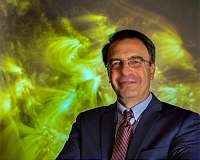
Scientists and engineers can spend their entire careers developing technologies and maybe, if they're lucky, fly them on a handful of missions. NASA scientist and innovator Nikolaos Paschalidis must be an extraordinarily lucky man.
With the launch of the European Space Agency's Solar Orbiter in February, Paschalidis, a scientist at NASA's Goddard Space Flight Center in Greenbelt, Maryland, has contributed mission-enabling instruments, instrument subsystems, and spacecraft avionics to 12 high-profile missions – a number that doesn't include the three CubeSat missions for which he contributed instruments. And that number is still climbing, with additional missions in the development pipeline.
Paschalidis's technological innovations are set to fly on two large satellites and four CubeSat missions in the future.
Difficult, Unusual Achievement
"Nick's achievement is very unusual and difficult, especially when you consider that these missions span the solar system," said Goddard Chief Technologist Peter Hughes, who recognized Paschalidis as his office's IRAD (Internal Research and Development) Innovator of the Year in 2015. He also received the agency's Exceptional Technology Achievement Medal in 2016 for his contributions conceiving, building, and flying important technologies and instruments on both CubeSat and flagship missions. "I'm awed by his achievement," Hughes said.
The native of Greece, who worked for the Johns Hopkins University Applied Physics Laboratory (APL) before joining Goddard in 2011, made the study of the Sun and its influence on the solar system his life's work. While at APL, he developed 10 different application-specific integrated circuits to carry out specific tasks.
They've been used on a plethora of missions, including NASA's New Horizons, Juno, Van Allen Probes, Cassini, Parker Solar Probe, and Magnetospheric Multiscale missions, to name just a few. The European Space Agency and the Japan Aerospace Exploration Agency also employed his highly specialized computer chips to enable instruments on BepiColombo, which launched in 2018 to study Mercury.
"What heartens me is that these technologies have been used continuously across the solar system: Sun, Earth, Moon and all the planets, except Neptune, as well as the Kuiper Belt beyond Pluto," Paschalidis said. "This is a huge variation in extreme environments, literally fire, ice, and killing radiation." It also attests to their staying power during long-duration missions. Cassini was active for nearly 20 years and New Horizons to Pluto is expected to remain active until 2021.
Paschalidis hasn't rested on his laurels since designing these integrated circuits more than 20 years ago. He's kept pace with new fabrication techniques, resulting in circuits that process data faster and consume less power and mass. He's also developed other system technologies, including detectors, collimators, which adjust the line-of-sight in telescopes, as well as other components that have resulted in more precise measurements.
Instruments NASA Needs
Following the tradition of conceiving and building technologies that NASA needs, Paschalidis more recently used IRAD support to create the miniaturized Ion-Neutral Mass Spectrometer, or INMS – the smallest instrument of its kind – which employs his ubiquitously used time-of-flight circuit. He and his team developed the instrument in less than a year – in of itself an accomplishment – to sample the densities of neutral and ionized gas species in Earth's upper atmosphere.
Paschalidis, who serves as the chief technologist for Goddard's Heliophysics Division, initially flew the instrument on the National Science Foundation's ExoCube, a CubeSat mission, and the again on the maiden flight of Goddard's Dellingr mission in 2017. He has since secured flight opportunities on the follow-on ExoCube 2 and PetitSat missions expected to launch in 2021, and more recently on Dione slated for a 2023 launch.
This instrument offers important capabilities for other small satellite missions, particularly those involving a constellation of spacecraft, to study the structure and dynamics of Earth's ionosphere, he said.
With IRAD funding he has started developing a new instrument, called the HELio Energetic Neutral Atom, or HELENA. While detectors currently in space observe energetic neutral
atoms, or ENAs, they require special techniques to see them close to the Sun. HELENA would provide the first-ever, unambiguous detection of ENAs erupting from the Sun.
ENAs are a key component in the sequence of space weather events that can be life threatening to humans living and working in space and disruptive to terrestrial power grids and communications systems. Understanding their acceleration is a NASA priority and one of the primary objectives of the Parker Solar Probe and Solar Orbiter missions.
Currently baselined for a proposed mission called the Science-Enabling Technologies for Heliophysics, or SETH, HELENA offers stand-alone applications – particularly for astronauts living on the Moon and those traveling to Mars. A HELENA-type detector could be used on the Moon to warn astronauts of potential space-radiation threats, giving them time to take cover.
"Providing new science measurements through cross-disciplinary capabilities is how I want to define my work at NASA." Paschalidis said, reflecting on his decades-long career as a scientist, with a background in electrical engineering.
