
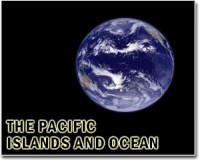
NASA has released a three-dimensional model of El Niño, a climate pattern marked by a mass of warm water in the Pacific Ocean.
The animated model presents the full life cycle of El Niño, beginning with its formation in January 2015 and ending with its dissipation in April 2016.
As trade winds blow east-to-west across the ocean, warm surface waters accumulate in the Western Pacific. When this happens, upwelling often occurs in the east, bringing cool, deep water to the surface.
The phenomenon slows the trade winds, or even reverses them, pushing the mass of warm water slowly eastward along the equator. Likewise, cooler water migrates westward.
The new 3D model shows warm surface water moving eastward during the summer months of 2015. Eventually, cooler water moving westward hits a boundary, spreads out and reflects back east. When the cooler water reaches the mass of warm water, temperatures become moderated and the climate pattern ends.
Both wind and water currents are featured in the 3D visualization. A series of pulsing winds can be seen traveling eastward toward South America during El Niño, before normalized trade winds return in 2016.
Hawaiian biodiversity began declining before humans arrived
New research suggests plant and animal diversity has been on the decline on all Hawaiian Islands, except for the Big Island, for several million years.
Researchers measured the decline using a new biodiversity analysis method. Scientists traced the history of diversity of 14 different groups of birds, insects, spiders and plants.
"It is increasingly appreciated that the biota of … read more
