
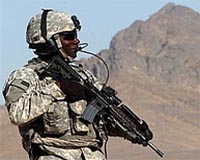
NATO commanders in Afghanistan need more troops and equipment to combat the Taliban, the alliance's top officer warned Monday, as insurgent attacks mount in southern and eastern regions.
US General John Craddock said that, based on a new assessment, the commanders would need three military brigades — around 10,000 troops — on top of the single brigade the United States is set to deploy in January.
"We need to fill up our military requirements, we also need then to expand and reach out to other areas — the civil-military efforts — so we have more capability to increase the government's growth," he told reporters.
"This is the creation of jobs, this is the creation of commerce. That's how the government will generate revenue, to be able to establish a budget and pay the bills. This all has to come together in this coherent way," he said.
He said that some 22 teams of trainers — numbering around 20 personnel per team — were also needed to help develop the expanding Afghan army.
The NATO-led International Security Assistance Force (ISAF) is comprised of some 51,000 troops drawn from 40 nations, and has increased in strength by some 73 percent over the last two years.
It is tasked with extending the reach of the weak centralised government across the country and to help rebuild.
But NATO's mission — its most ambitious ever — is being undermined by a Taliban-led insurgency focused mainly in the south and east of the strife-torn country.
Craddock said that the insurgency "is more virulent, it is of a higher tempo than it was last year."
"It is harder, tougher. More engagements, every day, every week, every month, by about 40 percent more," he told reporters at NATO's military headquarters in Mons, southern Belgium.
He said the increase was due to the sanctuary that some Taliban fighters were finding across the mountainous border in Pakistan, as well as extra funds coming in from the opium trade.
"If they have sanctuary, then whenever they choose they will come back. This will go on forever. That safe-haven, that sanctuary has to be eliminated," he warned.
Craddock also expressed hope that Pakistani security forces would be able to hold their ground in the border areas and eliminate some of the rear bases.
NATO's 26 member nations agreed last month to target the Afghan opium trade in a bid to stop hundreds of millions of dollars in drug money from reaching the insurgents, and Craddock said some operations were conducted last week.
"I haven't got the details yet," he said. "There are more that are in the planning stage. This is one of those that we are pushing hard to move forward."
Under the new plan, NATO troops now have a green light to hunt down drug lords and laboratories, but not to burn down poppy fields which could turn Afghan farmers against the alliance.
Rice to hold Europe talks on Afghanistan, NATO expansion
US Secretary of State Condoleezza Rice will discuss strategy to win the war in Afghanistan and NATO expansion at transatlantic alliance talks in Brussels next week, her spokesman said Monday.
On a tour that will also take her to London, Rome, Helsinki and Copenhagen, Rice will visit Brussels for the annual North Atlantic Treaty Organization foreign ministers' meeting on December 2-3, spokesman Sean McCormack said.
"I'm sure we're going to talk about Afghanistan," McCormack told reporters.
"We have been working on our own assessment, or review if you will of Afghanistan and the way forward," according to Rice's spokesman.
"I'm sure the secretary is going to be sharing how we see the situation," as others present their own views, he said.
He referred reporters to the White House for details on when the assessment will be completed, but said: "I think they're getting pretty close to wrapping things up."
He expected it to be completed "well before" President George W. Bush leaves office on January 20.
In September, Bush tasked Lieutenant General Douglas Lute, a deputy national security adviser, with leading a review of US strategy in Afghanistan, amid rising insurgent violence and tensions with Pakistan, a Pentagon official said.
McCormack also said the Bush administration still supports efforts for ex-Soviet republics Ukraine and Georgia to join NATO.
"I'm sure the issue will come up. Our policy is unchanged," McCormack said.
"I expect it to be a healthy discussion among the North Atlantic Council," he told reporters when asked if the Membership Action Plan (MAP) to pave the way for membership of these countries had lost support.
During an October 2 visit to Saint Petersburg, Russia, German Chancellor Angela Merkel said it was too soon for NATO to provide such a plan to Georgia and Ukraine.
Merkel said the NATO ministerial meeting in December that many predicted would be the occasion for the alliance to extend the plan to Georgia and Ukraine would instead be only "an initial evaluation on the road to MAP."
With nine former Soviet bloc countries already NATO members, Russia is fiercely opposed to more Soviet-era Warsaw Pact neighbours like Georgia and the Ukraine even starting the process of joining the western military alliance.
However, NATO Secretary General Jaap de Hoop Scheffer said during a visit to Spain last week that NATO will support efforts by former communist nations to join the military alliance despite Russia's opposition.
During her tour from November 30 to December 5, Rice will meet in London with British Foreign Secretary David Miliband before traveling to Brussels and then Rome, where she will meet Prime Minister Silvio Berlusconi and Foreign Minister Franco Frattini, McCormack said.
In Helsinki, she is due to take part in the Organization for Security and Cooperation in Europe ministerial meeting on December 4 as well as meet with with Finnish officials.
On her last stop in Copenhagen, she will meet Prime Minister Anders Rasmussen and Foreign Minister Per Stig Moller.
Share This Article With Planet Earth
