
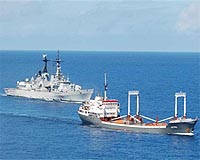
NATO is not considering any naval blockade as a way to combat piracy off Somalia, the alliance's secretary general said Monday, after maritime groups urged international action.
"Blocking ports is not contemplated by NATO," Jaap de Hoop Scheffer told reporters, adding that such action has not been endorsed by the UN Security Council. "This is, at the moment, not on the cards."
NATO has four ships — from Britain, Greece, Italy and Turkey — on patrol in the waters off Somalia, with two protecting UN food aid convoys to the strife-torn Horn of Africa country.
The mission, NATO's first-ever against pirates and which is commanded from Naples, southern Italy, ends in mid-December when a bigger European Union operation — dubbed Atalanta — is to be put in place.
Maritime groups have called on the United Nations to mount an international blockade to halt the surge of piracy, as well as clear rules of engagement that would allow foreign navies to intercept and prosecute the pirates.
"Maybe we should have the UN coordinating naval action off Somalia. It could impose a blockade along the Somali coast," Peter Swift of the London-based International Association of Independent Tanker Owners (Intertanko) said.
While NATO has ruled out a blockade, top alliance commander US General John Craddock said he had been tasked with mapping out future ways to combat piracy around the globe, including possible planning for land operations.
"I have been directed to examine long-term possibilities and involvement of NATO in counter-piracy operations and that work is ongoing," he said, and added: "You don't stop piracy on the seas. You stop piracy on the land."
When asked whether he would study possible land operations for the future, Craddock said: "I may well have to do that, right now I'm looking at the maritime aspect."
He underlined that no land operations were being considered in Somalia.
Share This Article With Planet Earth
