
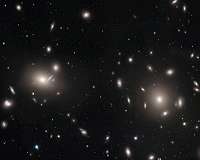
The paper was published in the last 2018 issue (Dec 20) of the Astrophysical Journal and was led by the astronomer of the University of Chile and researcher of the Center for Excellence in Astrophysics and Associated Technologies CATA, Luis Campusano.
Fritz Zwicky, famous American astronomer of Swiss origin, arrived in 1933 at the astonishing conclusion that even though galaxies are the signposts of galaxy clusters their contribution to the total cluster mass is minuscule in comparison to a dominant dark matter component. Current estimates of a cluster total mass indicate that the contributions roughly are: galaxies 1%, hot intracluster gas 9%, and dark matter the remaining 90%.
Until now these systems, megaparsec in size and with up to hundreds of trillions of solar masses, were easily recognized in visible light because of the brightness of the embedded galaxies and their concentration towards the cluster centers.
Because of their large masses and extent, clusters of galaxies are fundamental to the mapping and mass budget of the universe. New work by an international team of scientists suggests that perhaps as many as a third of all clusters have previously been missed. The study, conducted in the nearby universe, showed that the newly revealed clusters contain fewer, less packed, and less luminous galaxies, in comparison to the conventional clusters.
The discovery was made using public data for 191,440 galaxies from a major galaxy redshift survey (the "2dFGRS") conducted a decade ago with a robotic instrument at the 3.9-meter Anglo-Australian Telescope. The re-examination of the data ("Data-mining") through a computer-based procedure developed by this team, together with the abandonment of prejudices on the clusters' appearance, conducted to the reported discovery.
The complete list of co-authors and affiliations is: Gabriel Marinello (from ALMA Joint Observatory), Nancy Hitschfeld-Kahler, Sebastian Pereira and Daniel Pizarro (from the University of Chile), Roger G. Clowes (from Jeremiah Horrocks Institute, University of Central Lancashire), Christopher P. Haines (from Osservatorio Astronomico di Brera) and Ilona Sochting (Wartsila Corporation).
The Whole Story
The international team of astronomers and computer scientists showed, thanks to a computational algorithm, that not all the clusters (or swarms) of galaxies look the same in the optical range.
"We have found clusters with fewer and less luminous galaxies (spirals and irregulars) and more loosely packed towards the centers than the conventional clusters, properties that superficially give them an appearance not too dissimilar from ordinary regions of the sky. This is the main reason why they were unnoticed until now," explains Luis Campusano from the University of Chile in Santiago and lead author of the study.
"The result is as surprising as if geographers had missed a third of the high peaks in a mountain range such as the Andes because they had snow and were a bit flatter on their tops," adds Roger G. Clowes from the Jeremiah Horrocks Institute of the University of Central Lancashire, England, co-author of the article.
The discovery of a new class of massive clusters has important consequences.
"So far, the searches of clusters were based on the presence of bright elliptical galaxies, while the addition of new massive clusters increases their contribution to the mean mass of the universe. The realization that clusters of similar mass can have quite different galaxy contents is evidence that the particular history of each cluster is also relevant, and not simply its mass alone. The result poses new constraints to the theory of galaxy evolution," states Gabriel Marinello from the Joint ALMA Observatory, also co-author of this work.
The clue that allowed Campusano and his collaborators to find new large systems of "dark matter" was the implementation of a cluster finder that considered only the spatial distribution of the galaxies without concern for their brightness or for their morphology. The teamwork between astronomers and computing scientists was also fundamental.
The software identified clusters in the database that contains the positional information for the nearly 200,000 galaxies, by a geometric method that finds the galaxy overdensities that in turn lead to the recognition of a cluster's members through a velocity-gap that separates them from the general sky field. The resulting cluster sample proved to contain clusters reported in the literature and to provide a more complete cluster catalog.
Most cluster-finder algorithms rely on the proximity between galaxies, the so-called friends-of-friends method, which can blur the identification of the cluster core. In a comparison with the published results from other, earlier cluster-finders, working on the same galaxy dataset, the effectiveness of the new computational procedure developed by the team of astronomers and computer scientists was shown to be substantially improved.
Through detailed analyses, the authors showed that the new algorithm was not only able to detect the already-published clusters, but that it also revealed new clusters. It turned out that some of the new detections were "more of the same," which is unsurprising when improved methods are used. But some, and not a few, were revealed to have a different appearance. The detailed analysis of these extra detections led to the discovery being reported.
The First Galaxy Cluster
Arguably, the science of galaxy clusters started as early as 1781 with visual identification of overdensities in the distribution of nebulae over large areas of the sky by the French astronomer Messier. However, only relatively recently – in 1923 – were some of the nebulae first recognized as external galaxies by Edwin Hubble.
