
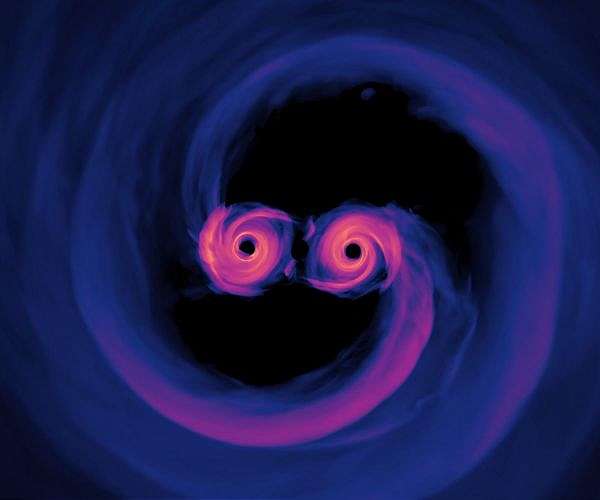
Binary neutron star mergers, occurring millions of light-years away, generate complex gravitational waves that challenge conventional data analysis methods. These signals can span minutes in current detectors and potentially extend to days with future observatories, making their interpretation computationally demanding and time-intensive.
A team of international researchers has developed DINGO-BNS (Deep INference for Gravitational-wave Observations from Binary Neutron Stars), a machine learning algorithm designed to accelerate this process. By leveraging a neural network, the system characterizes merging neutron stars in approximately one second-a significant improvement over the fastest existing methods, which take nearly an hour. The team's findings will be published in *Nature* on March 5, 2025, under the title "Real-time inference for binary neutron star mergers using machine learning."
Advancing Real-Time Computation
Neutron star mergers release electromagnetic signals, including visible light from kilonova explosions, alongside gravitational waves. "Rapid and accurate analysis of gravitational-wave data is essential for pinpointing the source quickly and directing telescopes to observe the accompanying signals," explains Maximilian Dax, the study's lead author and a Ph.D. student at the Max Planck Institute for Intelligent Systems (MPI-IS), ETH Zurich, and the ELLIS Institute Tubingen.
The introduction of real-time analysis through DINGO-BNS sets a new benchmark for interpreting neutron star mergers, enhancing the broader astronomy community's ability to respond swiftly once LIGO-Virgo-KAGRA (LVK) detectors identify such events.
"Current rapid analysis methods used by the LVK collaboration involve approximations that compromise accuracy. Our study eliminates these limitations," notes Jonathan Gair, a research leader in the Astrophysical and Cosmological Relativity Department at the Max Planck Institute for Gravitational Physics in Potsdam Science Park.
Unlike existing approaches, the machine learning-based framework delivers a full characterization of the neutron star merger-including mass, spin, and location-without approximations. This allows for a 30% improvement in pinpointing the sky position of these cosmic events. The algorithm's speed and accuracy facilitate joint observations with gravitational-wave detectors and electromagnetic telescopes, optimizing the use of valuable observing time.
Capturing a Neutron Star Merger in Action
"Analyzing gravitational waves from binary neutron star mergers presents unique challenges, necessitating several technical innovations for DINGO-BNS, including event-adaptive data compression," says Stephen Green, UKRI Future Leaders Fellow at the University of Nottingham. Bernhard Scholkopf, Director of the Empirical Inference Department at MPI-IS and the ELLIS Institute Tubingen, adds, "Our research highlights the potential of integrating modern machine learning with physical domain expertise."
DINGO-BNS holds promise for detecting electromagnetic signals both prior to and during the neutron star collision. "Early multi-messenger observations could shed light on the mysterious processes of neutron star mergers and kilonovae," states Alessandra Buonanno, Director of the Astrophysical and Cosmological Relativity Department at the Max Planck Institute for Gravitational Physics.
Research Report:Real-time inference for binary neutron star mergers using machine learning
