
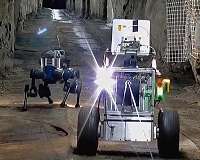
Team CERBERUS, an international collaboration based in the University of Nevada, Reno College of Engineering, has been selected to move on to the second round of the exclusive DARPA Subterranean Challenge, the Defense Advanced Research Projects Agency's latest robotics competition.
CERBERUS is one of 11 robotics teams from around the world that participated in the first round of the exclusive Subterranean Challenge in August. They brought their novel approaches to rapidly map, explore and search underground environments in time-sensitive operations critical for the civilian and military domains alike.
"We are even more excited for the future steps of the DARPA Subterranean Challenge and we look forward to the Urban and Cave Circuits in 2020," Kostas Alexis, associate professor in the Computer Science and Engineering Department, said.
"With the lessons learned from the Tunnel Circuit we aim to revolutionize how walking and flying robots can work collaboratively in a manner that provides a unified solution to the multiple challenges of subterranean robotic entry and exploration."
Led by Alexis, the CERBERUS team rolled out their technologies aimed at revolutionizing how robotic systems navigate and operate in the underground domain – human-made tunnel systems, urban underground settings and natural cave networks that are too dangerous, dark, deep and unknown to risk human lives.
"Our team got the sixth position out of 11 outstanding teams," Alexis said about the first challenge. "We knew from the beginning that our legged locomotion and flying robots approach would not be at maximum maturity – compared to, for example, wheeled platforms. We are confident, however, that our approach is the best way to go to provide a unified solution for all the environments the DARPA Subterranean Challenge is about; such as tunnels, caves and metropolitan underground infrastructure."
The second Challenge in February 2020, the Urban Circuit, features the exploration of underground metropolitan infrastructure such as a subway or sewers that can have complex layouts with multiple stories and span several city blocks. These areas are critical for search and rescue, security and other application domains.
The third Challenge in August 2020, the Cave Circuit, refers to the exploration of natural cave networks – environments that are also crucial for a variety of search and rescue applications. Natural cave networks often have irregular geological structures, with both constrained passages and large caverns.
Their walking and flying autonomous robots are equipped with multi-modal perception systems, navigation and mapping autonomy and self-organized networked communications. These features enable robust and reliable navigation, exploration, and mapping and object search.
"The experience of the Tunnel Circuit of the DARPA Subterranean Challenge was unique and extremely rewarding for the whole team," Alexis said. "It was a combination of extreme challenge and motivation, combined with working with good colleagues and getting to know more. We are honored that we had the chance to be there."
Photo Cutline: Using their legged robots, a wheeled communications vehicle, one advanced autonomous exploration aerial robot and one collision-tolerant aerial robot, Team CEREBERUS, an international collaboration based at the University of Nevada, Reno, competed at the first round of the DARPA Subterranean Challenge.
