
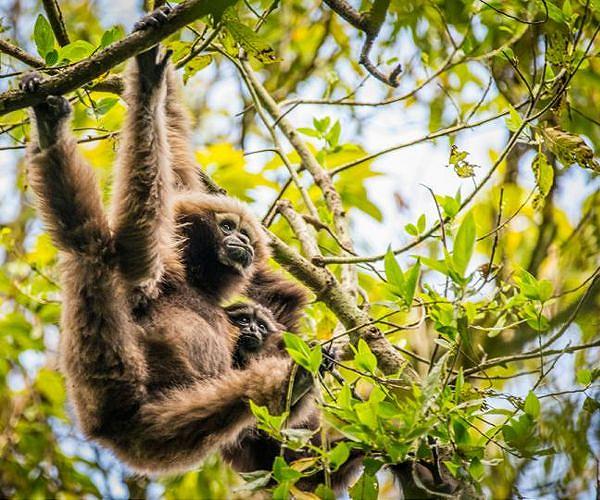
Scientists in southwest China on a digging expedition have discovered what they believe is the earliest fossil of a gibbon, and they say it solved part of a longtime mystery about the evolutionary chain of apes.
The fossil was unearthed in China's Yunnan province and scientists say it dates back several million years further than existing specimens, according to the findings published in the Journal of Human Evolution.
Because they are smaller in size than other apes, the gibbon — which is part of the hylobatid family of apes — is often called the "lesser ape" in comparison to the larger "great apes."
The fossilized small ape found in China is called Yuanmoupithecus xiaoyuan.
The researchers said the fossil indicates that the gibbon was similar in size to today's gibbons, and weighed about 13 pounds. They think it was about 2 years old when it died.
The discovery shines a new light on an evolutionary question about the evolution of apes.
"Genetic studies indicate that the hylobatids diverged from the lineage leading to the great apes and humans about 17 to 22 million years ago, so there is still a 10-million-year gap in the fossil record that needs to be filled," Terry Harrison, one of the authors of the study, said in a statement.
"With continued exploration of promising fossil sites in China and elsewhere in Asia, it is hoped that additional discoveries will help fill these critical gaps in the evolutionary history of hylobatids."
"Definitive fossil evidence of the evolutionary history of the hylobatids is unknown before the Early Pleistocene," the study says. "The lack of a fossil record in deep time is perplexing, given that molecular evidence indicates that hylobatids diverged from other hominoids."
Gibbons are believed to be the fastest of all tree-dwelling, non-flying mammals. The hylobatid family historically contained one genus, but is now split into four separate genera and 20 species.
"Hylobatids fossil remains are very rare, and most specimens are isolated teeth and fragmentary jaw bones found in cave sites in southern China and southeast Asia dating back no more than 2 million years ago," Harrison added.
"This new find extends the fossil record of hylobatids back to 7 to 8 million years ago and, more specifically, enhances our understanding of the evolution of this family of apes."
