
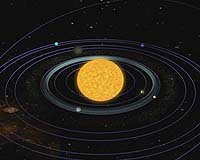
Scientists recently discovered a new frontier in the race to find life outside our solar system. Dying red giant stars may bring icy planets back from the dead.
Once-frozen planets and moons may provide a new breeding ground for life as their stars enter the last, and brightest, phase of their lives. Previous ideas about the search for extra-solar life had excluded these regions.
An international team of astronomers estimates that the emergence of new life on a planet is possible within the red giant phase.
"Our result indicates that searches for life-giving worlds outside our solar system should include planets around old stars," said Dr. Bruno Lopez of the Observatoire de la Cote d'Azur, Nice, France.
Lopez and his colleagues estimate that more than 150 red giant stars are close enough – within 100 light years – for upcoming or proposed missions to search for the signatures of life on distant worlds. A light year is the distance light travels in one year, almost six trillion miles!
Location, Location, Location
One of the secrets of Earth's success in producing life is its location within the sphere of the Sun's habitable zone. This sphere intersects the plane of the solar system to create a special donut-shaped boundary that outlines where water can exist as a liquid in our solar system, a necessity for the development of life.
Get too far from the Sun – and it's a lonely icebox. Too close – and the water evaporates into space, never to return again.
While the Earth currently sits well within this donut of life, our Sun is evolving and will one day grow to be a red giant star. Its habitable zone will expand with it, changing the locales where liquid water can splash and life may one day thrive.
In Light of the Sun, Mars May Be a Sound Investment
Lying just inside the outer limit of our Sun's habitable zone, Mars remains a frozen world today because of its thin atmosphere. However, when the Sun becomes a red giant a few billion years from now, Mars may become the happening place to be.
"Mars will be in the habitable zone for a couple billion years, so Martian life may get a second chance," said Dr. William Danchi of NASA's Goddard Space Flight Center, Greenbelt, Md.
In 2003, researchers monitored the amount of ice on Mars during its winter and spring seasons. In some regions, the water-ice content was more than 90% by volume. Scientists suspect that this water used to fill the planet's now-dry lakes and seas.
One day in the distant future, the frozen water on Mars may fill these dry basins again and bring forth new life in our solar system.
Red Giants Redefine the Search for Extra-Terrestrial Life
