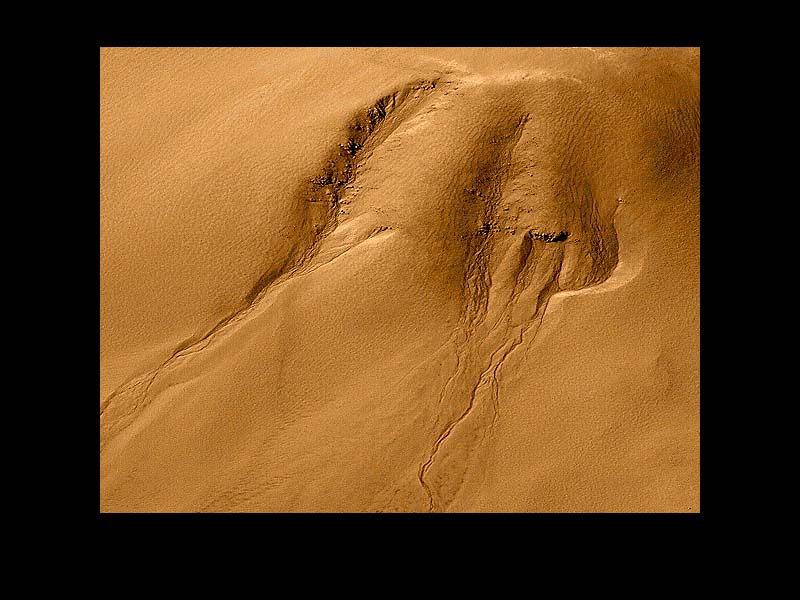
In what could turn out to be a landmark discovery in the history of Mars exploration, imaging scientists using data from NASA's Mars Global Surveyor spacecraft have recently observed features that suggest there may be current sources of liquid water at or near the surface of the red planet.
The new images show the smallest features ever observed from martian orbit — about the size of a sport-utility vehicle. NASA scientists compare the features to those left by flash floods on Earth.
"We see features that look like gullies formed by flowing water and the deposits of soil and rocks transported by these flows. The features appear to be so young that they might be forming today. We think we are seeing evidence of a groundwater supply, similar to an aquifer," said Dr. Michael Malin, principal investigator for the Mars Orbiter Camera on the Mars Global Surveyor spacecraft at Malin Space Science Systems, San Diego, Calif. "These are new landforms that have never been seen before on Mars."
Gullies eroded into the wall of a meteor impact crater in Noachis Terra. This high resolution view (above, left) from the Mars Global Surveyor (MGS) Mars Orbiter Camera (MOC) shows channels and associated aprons of debris that are interpreted to have formed by groundwater seepage, surface runoff, and debris flow.
The lack of small craters superimposed on the channels and apron deposits indicates that these features are geologically young. It is possible that these gullies indicate that liquid water is present within the martian subsurface today.
The MOC image was acquired on September 28, 1999. The scene covers an area approximately 3 kilometers (1.9 miles) wide by 6.7 km (4.1 mi) high (note, the aspect ratio is 1.5 to 1.0). Sunlight illuminates this area from the upper left
The image is located near 54.8¿S, 342.5¿W. The context image (above, right) shows the location of the MOC image on the south-facing wall of an impact crater approximately 20 kilometers (12 miles) in diameter.
The Mars Orbiter Camera high resolution images are taken black-and-white (grayscale); the color seen here has been synthesized from the colors of Mars observed by the MOC wide angle cameras and by the Viking Orbiters in the late 1970s.
Images Credit: NASA/JPL/Malin Space Science Systems
The findings will be published in the June 30 issue of Science magazine.
"Twenty-eight years ago the Mariner 9 spacecraft found evidence — in the form of channels and valleys — that billions of years ago the planet had water flowing across its surface," said Dr. Ken Edgett, staff scientist at Malin Space Science Systems and co-author of the paper in Science.
"Ever since that time, Mars science has focused on the question, 'Where did the water go?' The new pictures from Global Surveyor tell us part of the answer — some of that water went under ground, and quite possibly it's still there."
"For two decades scientists have debated whether liquid water might have existed on the surface of Mars just a few billion years ago," said Dr. Ed Weiler, associate administrator for space science at NASA Headquarters.
"With today's discovery, we're no longer talking about a distant time. The debate has moved to present-day Mars. The presence of liquid water on Mars has profound implications for the question of life not only in the past, but perhaps even today. If life ever did develop there, and if it survives to the present time, then these landforms would be great places to look."
The gullies observed in the images are on cliffs, usually in crater or valley walls, and are made up of a deep channel with a collapsed region at its upper end (an "alcove") and at the other end an area of accumulated debris (an "apron") that appears to have been transported down the slope. Relative to the rest of the martian surface, the gullies appear to be extremely young, meaning they may have formed in the recent past.
"They could be a few million years old, but we cannot rule out that some of them are so recent as to have formed yesterday," Malin said.
Recent Science Abstracts