
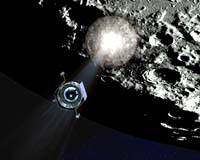
NASA officials said Monday the agency has chosen a smaller, secondary payload spacecraft to accompany its Lunar Reconnaissance Orbiter to the Moon in 2008. The tandem mission would be the first initiated under the Vision for Space Exploration articulated by President George W. Bush in January 2004.
"It's really a robust mission," Daniel Andrews, the mission's project manager, told reporters at a news briefing at NASA headquarters.
The secondary mission, called LCROSS – for Lunar CRater Observation and Sensing Satellite – is under development by Andrews's team at NASA's Ames Research Center in Moffett Field, Calif. It will piggyback aboard the rocket that launches the LRO and impact the Shackleton Crater at the Moon's south pole in October 2008.
The LCROSS concept edged out a similar spacecraft proposed by NASA's Jet Propulsion Laboratory in Pasadena, Calif. – and two other finalists, out of 19 possible missions and 40 proposals – because it features a second impact concept.
The mission will deploy the spent upper stage of the rocket carrying both the LRO and LCROSS as a primary impactor at Shackleton. It will hit the floor of the crater at a different location from LCROSS. The probe, called the shepherding spacecraft, will observe the upper-stage impact and its aftereffects – transmitting still images about once every other second – until hitting the Moon itself about 15 minutes later.
Both objects will be traveling at about 5,600 miles per hour (2.5 kilometers per second) and will knock football-field-sized holes in the crater's floor.
Mission planners expect a huge array of instruments – on Earth and in orbit, as well as the LRO – to observe the event and analyze the content of the ejected debris. Andrews said the debris cloud should rise as high as 35 miles above the lunar surface, and smaller particles should be driven higher and last for days.
Scott Horowitz, NASA's associate administrator for its Exploration Systems Mission Directorate, said the secondary mission idea arose last fall when he decided to opt for a bigger launch vehicle to carry the LRO. He told reporters that the original vehicle used a spin-stabilization system, which would have made it more difficult for the LRO to achieve a proper low-hanging orbit above the Moon's lumpy contours.
So agency officials decided to use a bigger rocket, which permitted about an extra ton (1,000 kilograms) of payload – hence the eventual addition of LCROSS.
Both missions, which NASA officials estimate will cost a total of $600 million, will travel to the Moon atop the Evolved Expendable Launch Vehicle, a rocket still under development that would be launched from Kennedy Space Center in Florida.
"We don't know for sure about the Moon," said Butler Hine of NASA Ames, the mission's deputy manager. "One of the LRO's primary missions is to map the poles and to search for water." He said the orbiter and the impactors will help NASA plan for future missions to the lunar surface, including sending crews to return to the Moon and develop a permanent human presence there.
The concept calls for LCROSS to reach the Moon independent of the LRO, although both spacecraft and the Earth Departure Upper Stage will make two large loops around both Earth and the Moon lasting 90 days. During that time, the LRO will power up and test its instrument array. Then, the shepherding spacecraft and EDUS will split off from the orbiter, and will remain coupled until just before they take aim at Shackleton Crater.
Horowitz said one remarkable aspect of LCROSS is the speed with which it was developed as a concept. NASA had asked for ideas for secondary payloads last Jan. 10. "We received a lot of great ideas (among the 19 selected) and we plan to use all of them eventually," he said.
