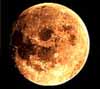
 Ann Arbor - November 12 , 1997 - University of Michigan geochemists have made the most accurate estimate yet of the age of our moon and discovered that it formed later in the development of the solar system than many scientists believed -- almost certainly as the result of a collision between Earth and another planet at least as large as Mars.
The interplanetary "big bang" between the Earth and another object occurred about 50 million years after the start of the solar system, according to Alexander N. Halliday, U-M professor of geological sciences.
In a study published in the Nov. 7 issue of Science, U-M scientists Der-Chuen Lee and Halliday, with Gregory A. Snyder and Lawrence A. Taylor of the University of Tennessee, explain how they analyzed isotopes of tungsten in rock samples from the lunar surface to unlock the secrets of the moon's origin.
"Our data indicate the moon formed within the time window of 4.52 billion to 4.50 billion years ago. The tungsten isotopic composition of the moon is consistent with the hypothesis that the moon was derived from the Earth itself, or from a large object colliding with the Earth which had a similar chemical composition," Halliday said.
"Simulations of the giant impact indicate phenomenally high temperatures of more than 10,000 degrees K., which triggered planet-wide mixing and melting of the rocky material in the young planet Earth," said Der-Chuen Lee, a U-M postdoctoral research fellow in geological sciences. "The heat and energy associated with the moon's formation were also responsible for producing its magma oceans."
Scientists believe the planets in our solar system began forming about 4.57 billion years ago from a huge cloud of interstellar gas, dust and debris leftover from the birth of the sun. The Earth and other rocky planets in the inner solar system built up gradually over millions of years as their gravitational pull attracted larger and larger chunks of material from the cloud.
Halliday and Lee used a technique called multiple-collector, inductively-coupled plasma mass spectrometry to measure extremely small amounts of tungsten isotopes in 21 lunar samples. "Since hafnium-182 decays into tungsten-182 with a half-life of 9 million years, it is possible to determine relative ages of materials based on their isotopic ratios," Halliday said.
The research project was funded by the U.S. Department of Energy, NASA, the National Science Foundation and the University of Michigan. Gregory A. Snyder and Lawrence A. Taylor of the University of Tennessee's Planetary Geosciences Institute were research collaborators and co-authors on the paper.
The University of Michigan
News and Information Services
412 Maynard
Ann Arbor, Michigan 48109-1399
Contact: Sally Pobojewski
Phone: (313) 647-1844
E-mail: [email protected]