
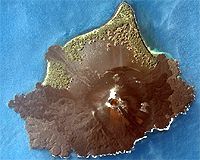
Indonesian scientists said Friday a spectacular eruption of lava, smoke and ash from the volcano that grew from the remains of the infamous Krakatau was not a threat, despite a nearby earthquake.
A 5.5-magnitude quake struck about 200 kilometres (125 miles) away from Anak Krakatau, located between the islands of Sumatra and Java, at 0655 GMT Friday, at a depth of 30 kilometres.
The 305-metre high (100-foot) island volcano began shuddering and spewing volcanic debris more than two weeks ago, prompting an alert for people to be wary of it.
They have been told to keep a three-kilometre (two-mile) distance from the peak, which started to form in 1927 from the remains of Krakatau, the renowned volcano that exploded with unprecedented force in 1883, killing 36,000 people.
"The tectonic quake could make Anak Krakatau more active as it would shake the magma and increase its gas volume," said volcanologist Agus Budianto.
But he said "it is not a threat to people as the volcano is located far away, some 40 kilometres (25 miles) offshore, from the nearest populated zones."
Another scientist, who gave his name as Anton, earlier told AFP that tremors at the volcano were fluctuating.
But "even if a main (explosive) eruption happened, looking at the historical behaviour of the volcano there would be no threat to people living on the coasts of Java and Sumatra," he said.
Lava flowing from the crater is not visible from the main islands, so volcano-watchers are chartering boats to get a better look. But they were still also warned to remain three kilometres away.
Several volcanoes in Indonesia, which sits on the Pacific "Ring of Fire" where continental plates collide, have roared to life in recent weeks.
Mount Kelut in East Java was put on red alert three weeks ago, meaning scientists feared an eruption was imminent and thousands were evacuated from villages on its slopes, but the warning was downgraded on Thursday.
Indonesia's islands are home to about 130 active volcanoes, including 21 on Java.
