
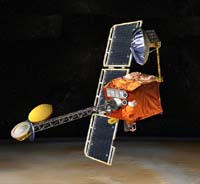
The Mars Odyssey 2001 space probe succeeded late Tuesday in entering the orbit of Mars to study the geology and chemical composition of the Red Planet, US space officials announced.
The spacecraft reached the Red Planet's orbit after it fired its main engine to slow down and execute a delicate maneuver to achieve its goal, according to officials at NASA's Jet Propulsion Laboratory (JPL) in Pasadena, California.
"We are on orbit around Mars. We are pretty excited," said Scott Henderson, one of the laboratory's mission managers.
The good news was greeted by cheers and applause at the JPL's mission control room, according to images broadcast by the National Aeronautics and Space Administration.
The Mars Odyssey entered the orbit after a 200-day, 460 million-kilometer (286 million-mile) voyage in space.
It is the first time a probe has approached Mars since the failure of the Mars Climate Orbiter and Mars Polar Lander probes in 1999.
As the Mars Odyssey approached the Martian north pole at close to 21,000 kilometers (13,050 miles) per hour, its main engine fired at 10:26 pm Washington time (0226 GMT), JPL spokesman Mary Hardin told AFP by telephone.
The engine thrust slowed the spacecraft down for 20 minutes before it disappeared behind the Red Planet for half an hour.
Contact with the Mars Odyssey was re-established at 10:56 pm (0256 GMT) as it emerged from behind Mars, confirming that the maneuver was successful.
Before swinging into Martian orbit, the spacecraft's volleyball-size fuel tanks had to be pressurized and the hydraulic pipes heated up. In 20 minutes of ignition, they burned 262.9 kilograms (579.6 pounds) of fuel.
The Mars Odyssey's initial, elliptical orbit around the Red Planet will last 19 hours before it is adjusted by a series of delicate breaking maneuvers, called
