
Crude oil benchmarks were pulled in opposite directions early Monday as Tropical Storm Harvey battered the U.S. coast while global economies improved.
Harvey sidelined about half of the regional refining capacity because of historic flooding. As much as 4 feet of rain is expected in the Houston metropolitan area and the Eagle Ford shale basin, which accounts for about 10 percent of the total U.S. daily production, is directly in the storm's path.
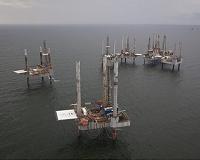
Energy companies working in the Gulf of Mexico, which accounts for about a quarter of total U.S. production, are starting to return staff to some offshore platforms as Harvey moves inland. Vandana Hari, an industry analyst and founder of Vanda Insights, said in a daily newsletter the market was "not too concerned" by any Harvey-related shortages in crude oil supply.
"The lower crude availability will be partly mitigated by reduced demand from the refining system as a result of some of the capacity being offline," she said. "Besides, U.S offshore crude supplies and imports could be restored sooner, given the preliminary assessment of no major damage sustained at the production platforms and import/export terminals."
This means U.S. crude oil supplies could recover before the refineries are back in action. Gasoline futures, meanwhile, were up about 6 percent from Friday's close, signaling upward pressure at the consumer level later this week. Any spike at the pump would come just as U.S. motorists gear up for the last major holiday of the summer travel season and Harvey may wind up influencing demand.
West Texas Intermediate, the U.S. benchmark for the price of oil, was down 0.79 percent at 9:13 a.m. EDT to $47.49 per barrel. Brent crude oil, the global benchmark, was up 0.17 percent to $52.50 per barrel.
"Brent crude is strong as European refineries ramp up activity to replace U.S. product imports and reports of shut production in Libya," Phil Flynn, senior market analyst for the PRICE Futures Group in Chicago, said in response to emailed questions.
Libya is exempt from a program led by the Organization of Petroleum Exporting Countries to drain a surplus on the five-year average of global crude oil inventories through managed declines. Small fits and starts from Libya, therefore, have big market implications.
On the economic front, the Organization for Economic Cooperation and Development said quarterly growth in real gross domestic product for its members was up 0.7 percent in the second quarter, compared with 0.5 percent in the previous quarter. Japan led the pack with a jump from 0.4 percent to 1 percent, while the British economy shrank from 0.3 percent to 0.2 percent in the second quarter. GDP in the United States, the world's leading economy, grew from 0.3 percent to 0.6 percent.
"Year-on-year GDP growth for the OECD area accelerated to 2.4 percent in the second quarter of 2017, compared with 2.1 percent in the previous quarter," its preliminary estimate for the second quarter read.
Norway's Statoil takes first steps into Argentina's lauded shale
Norwegian energy company Statoil said Friday it signed an agreement with Argentine company YPF to explore parts of the "world-class" Vaca Muerta shale basin.
Statoil under the terms of the agreement took a 50 percent stake in the Bajo del Toro exploration permit in the Neuquén Basin alongside YPF. The Norwegian company said it would fund all of the costs associated with activities in t … read more
