
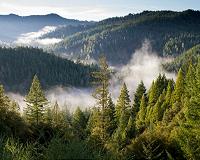
An indigenous tribe and a major oil company, along with Canada's government carved out Tuesday a new boreal forest conservation area to abut protected lands now twice Belgium's size.
The partnership brought together by Nature Conservancy of Canada creates a 3,300-square-kilometre (1,274-square-mile) conserved area in northeast Alberta province.
When added to the adjacent Richardson, Kazan and Birch Mountain, as well as Wood Buffalo National Park to the north, the new Birch River Wildland Provincial Park forms what the Nature Conservancy called the "largest stretch of protected boreal forest on the planet."
The total protected area, a haven for 68 at-risk species including peregrine falcons, wood bison and woodland caribou, is more than twice the size of Belgium or 67,735 square kilometres (26,153 square miles).
"We're building on Wood Buffalo, which is already one of the largest parks in the world," Bob Demulder, an Alberta executive with the Nature Conservancy, told AFP.
The Nature Conservancy paved the way for the deal by buying and retiring the Tallcree tribe's timber rights in the new park for Can$2.8 million (US$2.2 million), with most of the funding provided by Syncrude — one of the largest producers in the nearby Alberta oil sands.
Syncrude offered to fund the buyback in exchange for future "biodiversity offsets" that will allow it to develop other lands in Alberta, and the deal became a "catalyst for (Alberta's) creation of the Richardson and Kazan parks," Demulder said.
The boreal forest (or taiga biome) stretches across the northern hemisphere. In Canada, its conifer forests, bogs and ferns cover almost 60 percent of Canada's land area.
The Birch River Wildland Provincial Park is remote. "It's good for critters, but hard for people to reach," Demulder commented.
Its creation will help the Tallcree maintain their hunting and fishing "traditional way of life," said chief Rupert Meneen. The tribe will share responsibility with Alberta for overseeing the wildlands.
The new park will also contribute to Canada's pledge to conserve 17 percent of its land and inland waters by 2020.
