
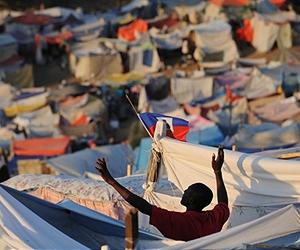
On a dry hillside north of Port-au-Prince, hundreds of people gathered Monday to mourn earthquake victims dumped in mass graves here, where opponents of Haiti's brutal dictatorships were once buried.
On a hilltop overlooking the Caribbean Sea, a digger cleared a plot of land, and the smell of death mingled with the weeping of some 350 mourners saying their final goodbyes to friends and family killed in the January 12th quake.
The 7.0-magnitude tremblor wrought unprecedented destruction on this nation's capital, killing at least 170,000 people. In the hellish days after the quake, the bodies of many of those killed in the disaster were brought here in trucks, dropped off and covered in soil.
Even now, mounds protrude indicating the location of corpses and in places bodies, like that of a woman curled up in the fetal position, can be seen.
"Until now, I have not had a chance to honor the memory of my dead classmates," said Desermithe Pierre, 16, who joined a choir to sing at the mass.
She wore a blue skirt, a white shirt and a yellow tie and, like most of those gathered on the arid hilltops to say their final farewells, she sported a black mourning band tied around her arm.
"We're going to sing songs of sadness, the songs we sing for the dead," she said, visibly upset.
Not far away, in the barren and stony ground, a white cross was planted.
"At least we know that they are in a better world," said Jocely Lamaret, a large woman wearing a silk dress and a hat.
Melancholy Creole songs rang out as the sun beat down on the site, where many believe their relatives are buried, but will never know for sure.
The pain of the mourners was undeniable, but the mass that at first appeared spontaneous was in fact organized by the Lavalas Family Party, affiliated with Haiti's exiled former president Jean-Bertrand Aristide.
The name of the former president, now living in South Africa, was invoked by his supporters after religious ceremonies were done.
"Because of the wickedness of the authorities, Aristide cannot attend this ceremony in memory of the thousands of victims of the catastrophe of January 12," said Rene Civil, an official from the Aristide Foundation for Democracy.
"But with the help of the Lavalas activists, Titid will return to Haiti before long," he added, using a nickname for the former Haitian leader.
"Long live Aristide," he shouted to the crowd, some of whom repeated back the cry.
Priests led mourners in a short procession up one slope, where they placed a cross and flowers to honor the dead.
Some prayed, others broke down crying. Some covered their faces to block out the sun and the smell of death wafting in on sea breezes.
Eventually the procession made its way back down the hill, with mourners piling into eight minibuses provided by the Lavalas Party, ready to ferry them back to Port-au-Prince.
The mourners gone, a group of children wandered over to the cross, eager to discover whether it was made of wood that could be sold.
Upon closer examination they saw that it was iron, and wandered away, looking for something else they might sell or exchange for food or clothes.
Share This Article With Planet Earth
