
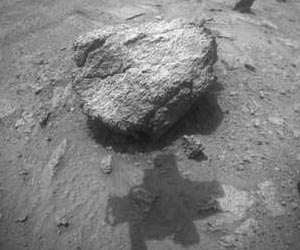
Opportunity completed the in-situ (contact) investigation on the surface target Ruiz Garcia at Santa Maria crater.
On Sol 2520 (Feb. 25, 2011), the rover used the robotic arm (Instrument Deployment Device, or IDD) to collect a microscopic imager (MI) image mosaic of Ruiz Garcia.
Then, it placed the alpha particle X-ray spectrometer (APXS) down on the target for multi-sol integration. On Sol 2531 (March 8, 2011), the rover backed away from the target and drove about 8.7 meters (29 feet) north to set up for the final wide-baseline stereo imaging, the last imaging before leaving Santa Maria crater.
As of Sol 2532 (March 9, 2011), solar array energy production was 412 watt-hours with an elevated atmospheric opacity (Tau) of 1.05 and a solar array dust factor of 0.5565.
Total odometry is 26,695.66 meters (26.70 kilometers, or 16.59 miles).
Latest Spirit Update
No communication has been received from Spirit since Sol 2210 (March 22, 2010).
Deep Space Network X-band listening and "Sweep and Beep" commanding continue. The project has been systematically conducting the Sweep and Beep commanding over a range of frequency reference offsets and over a range of local solar times on Mars. This covers the possibility that the rover's receiver has degraded and/or the clock has drifted significantly since March of 2010.
Shortly, the project will command the use of the backup transmitter (in case the primary transmitter has failed), and will command extra-long ultra-high frequency (UHF) passes to account for possible timing drift of the relay passes, and to make the rover responsive to UHF relay (if it is has experienced a mission-clock fault). Normally, only X-band communication is possible under mission-clock fault.
Total odometry is unchanged at 7,730.50 meters (4.80 miles).
Share This Article With Planet Earth
